As vanadium resources become increasingly scarce, the recovery of vanadium from secondary resources such as vanadium-rich iron slag, spent vanadium catalysts, and stone coal ash is attracting growing attention across the industry. Vanadium recovery from secondary resources typically involves three core processes: vanadium leaching, extraction, and precipitation. The commonly used vanadium extraction methods include chemical precipitation, solvent extraction, and ion exchange. Among these methods, solvent extraction offers advantages such as relatively low production costs, rapid equilibrium, a regenerable and recyclable organic phase, and ease of automated control. It performs well in terms of vanadium recovery rate, product purity, and processing capacity, and can, to a certain extent, compensate for the limitations of ion exchange and chemical precipitation in environmental protection, economic efficiency, and production capacity.
However, existing vanadium extraction technologies still have certain shortcomings. Improper treatment of industrial waste gas, wastewater, and solid waste can cause environmental pollution. In addition, low single-stage extraction efficiency, complicated multistage extraction processes, and significant extractant losses limit their application.
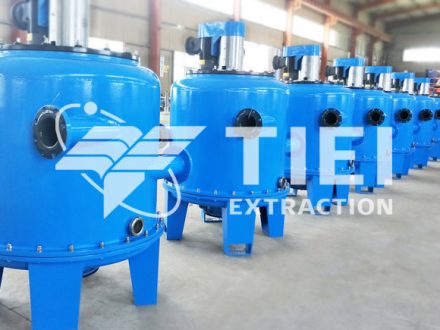
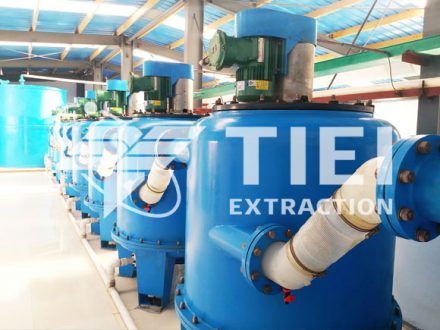
To address these challenges, Zhengzhou Tiei Extraction Technology Co., Ltd. has introduced the CWL-M centrifugal extractor and its supporting vanadium extraction process. This process reduces environmental pollution while improving extractant utilization and vanadium extraction efficiency, and simplifies the overall process.
The specific process steps are as follows:
1.Preparation of the Feed Solution
The spent vanadium catalyst is ground and subjected to water leaching and reductive acid leaching. The resulting water leachate and reductive acid leachate are combined to obtain the feed solution for extraction.
2.pH Adjustment
Potassium hydroxide solution is added to the feed solution to adjust its pH to an appropriate range.
3.Extractant Saponification
The extraction system uses P204 as the primary extractant, 2-octanol as the phase modifier, and No. 260 solvent oil as the diluent. P204 is saponified with sodium hydroxide, with the saponification rate controlled at 70%–80%.
4.Centrifugal Extraction
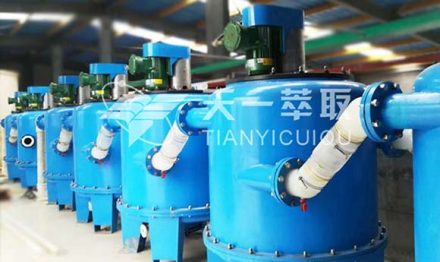
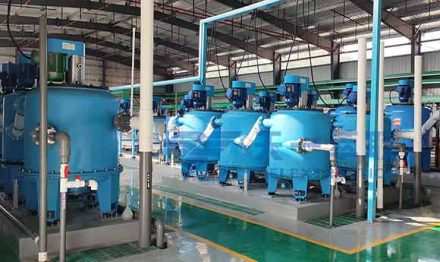
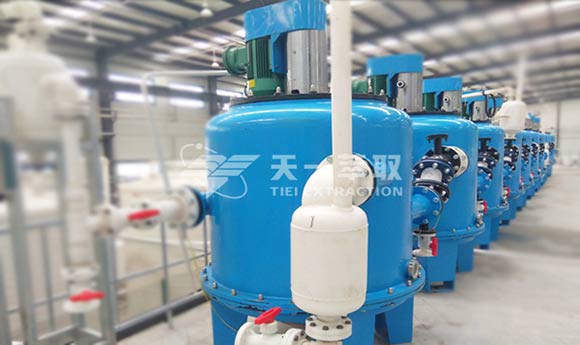
At the optimized phase ratio, the feed solution and extractant are continuously introduced through the heavy-phase and light-phase feed inlets of the CWL-M centrifugal extractor, respectively, for single-stage extraction, producing an extraction phase containing tetravalent vanadium and a raffinate.
As the core liquid-liquid extraction equipment, the CWL-M centrifugal extractor utilizes a centrifugal force field to achieve rapid mixing and efficient separation of the two phases. It offers high mass transfer efficiency and rapid phase disengagement. Compared with traditional mixer-settlers, it can significantly shorten extraction time and reduce entrainment.
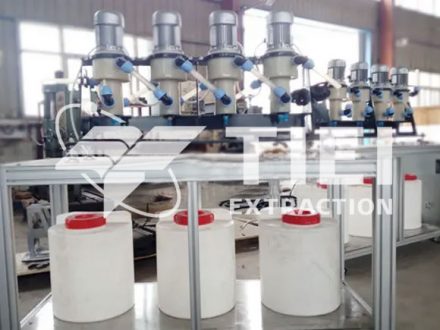
For projects where the process is still undergoing validation, laboratory-scale extraction equipment can first be used for preliminary testing. Key parameters, including the phase ratio and number of extraction stages, can then be determined to support the selection of industrial-scale equipment.
5.Stripping
Sulfuric acid is added to the extraction phase as the stripping agent to perform stripping, producing a stripped organic phase and an aqueous stripping phase. The stripped organic phase can be regenerated and recycled, reducing extractant consumption.
6.Vanadium Precipitation
Ammonia water is added to the aqueous stripping phase to adjust its pH. The solution is stirred at 70–90°C for 45–55 minutes to produce hydrated vanadium dioxide precipitate. The precipitate is washed with clean water and then calcined to obtain vanadium pentoxide (V₂O₅).
This process employs single-stage extraction of the feed solution, with the raffinate collected and separately subjected to further extraction. Under suitable process conditions, the single-stage extraction rate can reach 96.4% or higher. The tetravalent vanadium obtained through extraction can be directly precipitated without oxidation. This avoids the atmospheric pollution caused by chlorine gas generated when chlorates are used to oxidize vanadium. The process also improves the extraction capacity and utilization of the extractant, increases the vanadium extraction rate, reduces the number of extraction stages, and eliminates the oxidation step. These improvements simplify the process, lower production costs, and deliver significant economic benefits.
In terms of extraction system selection, saponified P204 is used as the primary extractant. It has low water solubility, forms metal complexes with high solubility in the diluent and high stability, and is inexpensive and readily available. Combined with 2-octanol and No. 260 solvent oil, this system enables single-stage extraction of the feed solution. This not only improves the extraction rate and enhances vanadium-iron separation, but also effectively prevents iron, phosphorus, and arsenic from affecting the purity of the extracted vanadium. As a result, some impurity removal steps can be reduced, raw material consumption can be lowered, and high-purity vanadium products can be obtained directly.
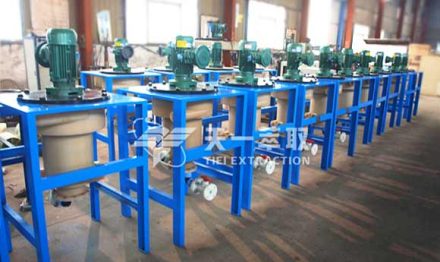
Zhengzhou Tiei Extraction Technology Co., Ltd. provides a complete product range, from laboratory-scale extraction equipment to industrial-scale CWL-M centrifugal extractors. As a professional supplier of extraction and separation equipment, the company can provide process design and equipment selection support based on customers' feed solution systems and processing capacities.
For more detailed vanadium extraction process or equipment configuration proposals for the CWL-M centrifugal extractor, please contact Zhengzhou Tiei Extraction Technology Co., Ltd. for further consultation.
Email: sales@tieiextraction.com
Whatsapp: +86 19069612820