Beryllium is an important strategic rare metal with irreplaceable applications in aerospace, electronic devices, precision manufacturing, and other fields. As high-grade beryllium resources become increasingly scarce, how to efficiently and continuously extract beryllium oxide from low-grade beryllium ores and concentrates has become a key focus in the field of hydrometallurgy.
Chrysoberyl is one of the most important beryllium minerals after beryl. It is often associated with small amounts of phenakite, taaffeite, and other minerals. Its BeO content generally ranges from 0.15% to 1%, making it a low-grade beryllium resource. Traditional sintering of beryllium concentrates often requires large quantities of fluxes such as calcite and sodium fluorosilicate, resulting in high costs and complex processes. Studies have shown that fluorite significantly promotes the roasting decomposition of chrysoberyl. Therefore, some of the fluorite in the ore can be floated together with chrysoberyl to obtain a low-grade but high-recovery beryllium concentrate, which can then be processed through hydrometallurgy to extract beryllium oxide.
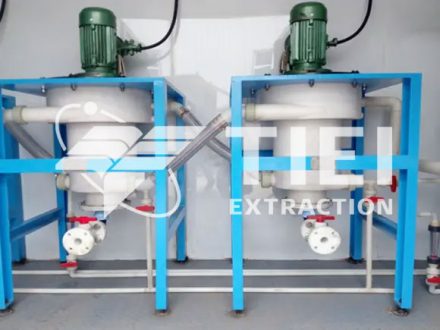
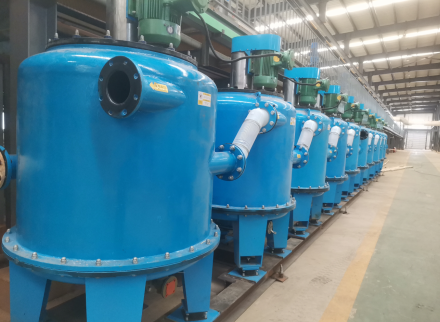
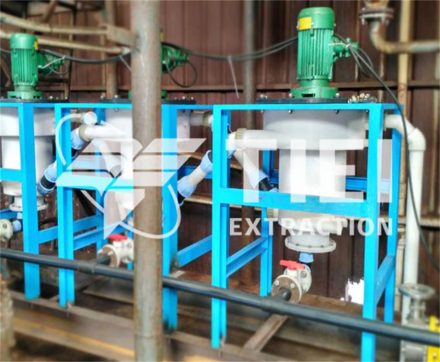
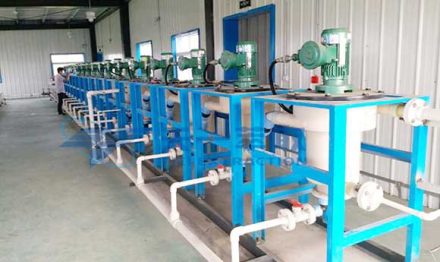
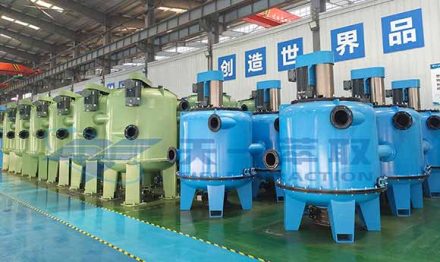
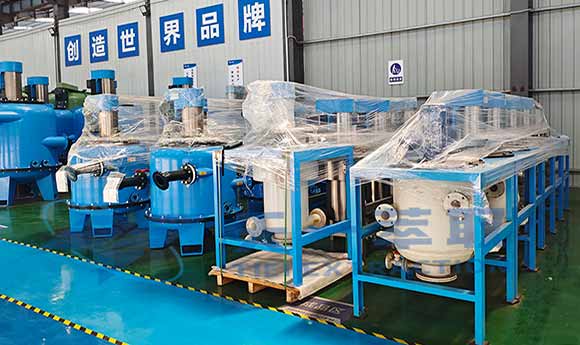
The entire process mainly consists of four core stages: leaching, extraction, stripping, and precipitation and calcination. Among these, extraction and stripping are the key stages that determine beryllium recovery and product purity, and they are also where centrifugal extraction equipment delivers its main advantages. The CWL-M series centrifugal extractors independently developed and manufactured by Zhengzhou Tiei Extraction Technology Co., Ltd. hhave established mature application solutions for metallic beryllium extraction processes.
Process Flow for Extracting Beryllium Oxide from Beryllium Ore
1.Leaching
After roasting, cooling, crushing, and grinding, the beryllium concentrate is stirred and leached with a dilute sulfuric acid solution for 60–90 minutes. Solid-liquid separation is then performed to obtain a beryllium-containing leach solution that meets the requirements for subsequent extraction.
2.Centrifugal Extraction
The beryllium-containing leach solution enters the extraction stage. P204:2-octanol:kerosene (volume ratio of 30:8:62) is used as the extraction system. Four-stage countercurrent extraction is carried out under optimized phase-ratio conditions to obtain a beryllium-loaded organic phase and a raffinate. This stage can be performed using CWL-M centrifugal extractors, which achieve rapid mixing and efficient separation of the two phases through a centrifugal force field.
3.Stripping
The beryllium-loaded organic phase is first washed with an oxalic acid solution and then subjected to three-stage countercurrent stripping with a NaOH solution to obtain a barren organic phase and a stripping solution. The stripping process can also be completed in CWL-M centrifugal extractors, which can be configured with corrosion-resistant materials according to the requirements of the alkaline solution system.
4.Precipitation and Calcination
The stripping solution is adjusted with dilute sulfuric acid and then boiled for approximately 30 minutes to hydrolyze and form a Be(OH)₂ precipitate. After solid-liquid separation, the precipitate is calcined to obtain the beryllium oxide product.
Throughout the process, extraction and stripping are the key stages that determine recovery and product purity. The phase-separation capability and continuous operating stability of the equipment directly affect the performance of the entire production line.
Core Advantages of Centrifugal Extractor in Beryllium Extraction
Compared with traditional mixer-settlers, CWL-M centrifugal extractors offer significant advantages in terms of continuous operation and phase separation in beryllium extraction processes. Mixer-settlers rely primarily on gravity settling to separate the two phases. Their residence times are relatively long, and separation performance can be easily affected by emulsification and interfacial contaminants. They also occupy a relatively large area. Although continuous operation is possible, interface control tends to lag behind process changes, organic-phase holdup is relatively high, and maintenance points are numerous.
In contrast, CWL-M centrifugal extractors use a centrifugal force field to achieve rapid mixing and efficient separation of the two phases. They feature short stage residence times and faster, more stable phase separation. Their compact structure requires less floor space, making them suitable for continuous and stable operation. Meanwhile, their low liquid holdup helps reduce organic-phase retention and solvent losses. In terms of maintenance and energy consumption, the CWL-M series features structural optimization, with bearings and mechanical seals eliminated from the bottom of the equipment, substantially reducing maintenance costs. Its power consumption is only 1/10 to 1/3 that of traditional centrifugal extractors.
Zhengzhou Tiei Extraction Technology Co., Ltd. has implemented multiple material and structural upgrades to the CWL-M series centrifugal extractors. In addition to stainless steel, special materials such as fluoropolymers can be used for wetted components to resist corrosion from strong acids, strong alkalis, and organic solvents. For hydrometallurgical processes such as beryllium extraction that require continuous and stable operation, these designs help reduce downtime for maintenance and improve the overall availability of the production line.
From Laboratory Testing to Industrial Equipment Selection
For beryllium extraction projects that are still in the process development stage, it is recommended to first use laboratory-scale centrifugal extractors for small-scale testing to determine key parameters such as phase ratio, number of stages, flow rate, and phase-separation conditions, and then proceed with industrial equipment selection. The CWL-M series centrifugal extractors offers a complete product line ranging from laboratory-scale centrifugal extractors to industrial centrifugal extractors, facilitating the phased development of projects.
Conclusion
From beryllium ore to beryllium oxide, the continuous and efficient operation of the entire extraction process depends on reliable equipment support. Among the four stages of leaching, extraction, stripping, and precipitation and calcination, extraction and stripping directly determine beryllium recovery and the purity of the beryllium oxide product. With advantages such as short residence times, rapid phase separation, compact footprint, and corrosion-resistant materials, CWL-M centrifugal extractors provide a solution for the continuous operation of efficient and clean beryllium extraction.
Email: sales@tieiextraction.com
Whatsapp: +86 19069612820