The treatment of phosphoric acid waste liquid is shifting from “neutralization and discharge” toward “resource recovery and value creation.” In the past, large volumes of phosphoric acid-containing waste liquids were treated with lime neutralization and disposed of as calcium phosphate sludge, resulting in the loss of valuable phosphorus resources. Today, as discharge limits continue to tighten and phosphorus is widely recognized as an irreplaceable critical resource, both the economic and environmental cases for phosphoric acid recovery have become increasingly compelling. The challenge is that phosphoric acid waste liquids are rarely composed of “pure phosphoric acid.” They also contain heavy metals, fluorides, and organic contaminants, making separation far more difficult than in conventional wastewater treatment. Solvent extraction is currently one of the most technically viable recovery routes for industrial applications, and the choice of extraction equipment directly determines whether the process can operate reliably.
Why Traditional Extraction Equipment Struggles with Phosphoric Acid Waste Liquid
Mixer-settlers and extraction columns have long been established as conventional equipment in phosphoric acid purification. Mixer-settlers can achieve stage efficiencies of over 90%, but they require large floor areas, involve high capital investment, and incur substantial operating costs. Extraction columns are sensitive to operating parameters, require frequent cleaning, and have limited adaptability to systems containing suspended solids or prone to emulsification. The composition of phosphoric acid waste liquid further magnifies these limitations: the coexistence of heavy metal ions, fluorides, and organic compounds makes emulsification more likely, resulting in incomplete phase separation, increased entrainment, and higher solvent losses.
Centrifugal extractors take a different approach. Rather than relying on gravity settling, they use the centrifugal force generated by a high-speed rotating drum to achieve forced phase separation. The centrifugal field can reach 500–2,000 times the force of gravity, allowing the two phases to complete mixing, mass transfer, and separation within an extremely short period. Single-stage extraction efficiency can exceed 90%. For phosphoric acid waste liquids characterized by complex impurities, a tendency to emulsify, and the need for rapid processing, the advantage of centrifugal force is not simply greater speed, but more controllable separation.
The Process Positioning of the CWL-M Centrifugal Extractor: Integrating Separation into Every Stage
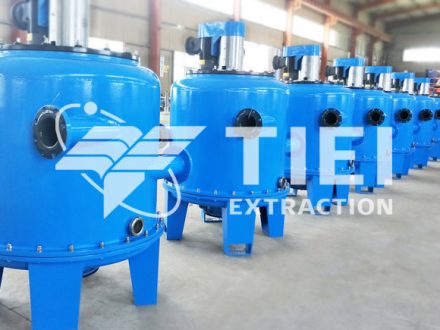
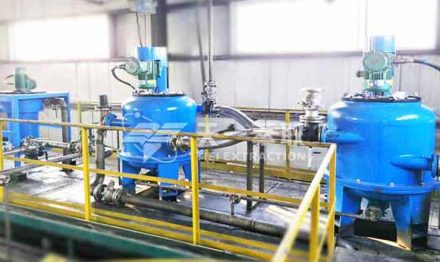
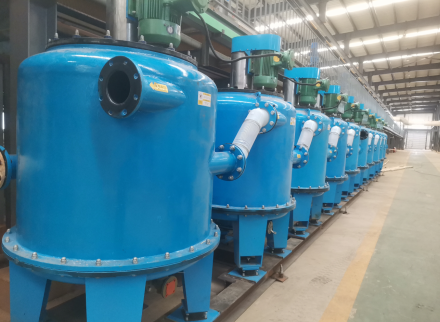
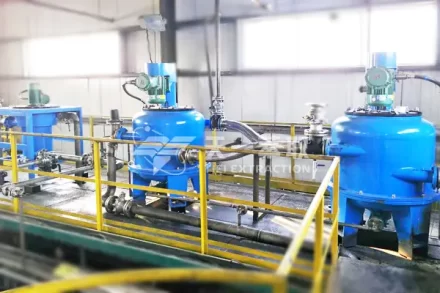
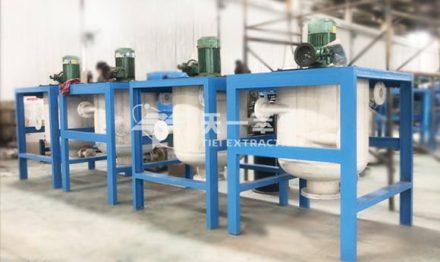
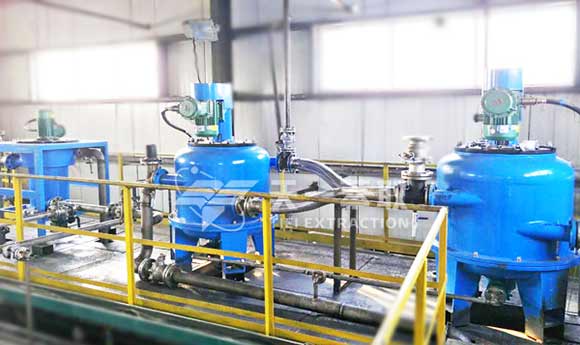
The CWL-M centrifugal extractor is developed by Zhengzhou Tiei Extraction Technology Co., Ltd. for liquid-liquid extraction and separation applications. Its mixing capacity ranges from 1 to 150,000 L/h, making it suitable for different scales of operation, from laboratory validation to continuous industrial production. In the complete phosphoric acid waste liquid recovery process, its role is not merely to provide an additional separation step at the end, but to control separation precision and material losses at every stage.
1.After pretreatment, the extraction system determines the outcome.
Once the waste liquid has been filtered to remove suspended impurities and its pH adjusted, it proceeds to the extractant selection stage. TBP (tributyl phosphate) is one of the most widely used extractants in phosphoric acid recovery, primarily because of its selectivity. Its distribution coefficient for Fe³⁺ can reach 15–20, while its extraction rate for H₃PO₄ is below 5%. This means that, with appropriate phase ratios and stage configurations, impurities such as iron and aluminum are preferentially transferred into the organic phase, while phosphoric acid remains in the aqueous phase for purification and recovery. In other words, the process extracts impurities rather than phosphoric acid itself, leaving the phosphoric acid in the raffinate in a purer form. This selective separation window also offers engineering value for removing fluorides and certain heavy metals from phosphoric acid waste liquids.
2.Mixing and phase separation: Replacing gravity settling with centrifugal force.
After the waste liquid and extractant enter the CWL-M centrifugal extractor at the specified ratio, the mixing impeller rapidly disperses the two phases to promote mass transfer. The high-speed rotating drum then completes phase separation. The equipment adopts an overhead suspension structure with a single support point. There are no bottom bearings or mechanical seals in the processing zone, structurally eliminating leakage risks and reducing maintenance frequency under strongly acidic operating conditions. In terms of corrosion resistance, the CWL-M centrifugal extractor can be manufactured using all-fluoropolymer materials to withstand highly corrosive media such as hydrochloric acid and mixed acids. This is an essential configuration for phosphoric acid waste liquids, which typically operate under strongly acidic conditions. Regarding power consumption, under the same processing capacity, the energy consumption of a centrifugal extractor is only 10%–30% of that of a conventional annular-gap extractor. This difference translates directly into operating cost savings in continuous operation.
3.Multistage counter-current extraction: Achieving recovery rates through process configuration rather than brute force at a single stage.
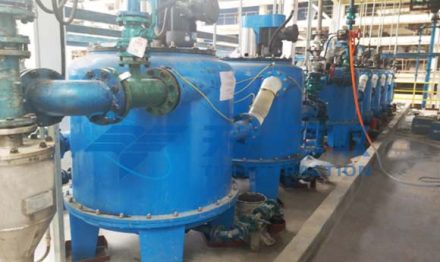
Single-stage extraction is rarely sufficient to meet both recovery and selectivity requirements. The CWL-M centrifugal extractor supports multistage counter-current operation through series connections, enabling gradient enrichment of impurity ions and thorough recovery of the target components through appropriate stage configurations. Centrifugal extractors are particularly suitable for low-concentration phosphoric acid systems. According to engineering data, for crude phosphoric acid with a P₂O₅ mass concentration of 6–11 wt% undergoing iron removal, the yield can exceed 99%. The short stage residence time and rapid phase separation help keep solvent holdup under control in multistage configurations, reducing the cumulative risks of extractant degradation and emulsification.
4.Washing and stripping: Recovering the phosphoric acid from the loaded organic phase.
After washing to remove entrained phosphoric acid and impurities, the loaded organic phase is stripped using deionized water or dilute phosphoric acid, transferring the phosphoric acid into a fresh aqueous phase while allowing the organic phase to be recycled. The resulting strip liquor can undergo further treatment, such as concentration and crystallization, to produce phosphoric acid for reuse in production or commercial sale. The low liquid holdup design of the CWL-M centrifugal extractor is equally beneficial at this stage: when the system is shut down or switched between operating conditions, the amount of residual material is small, correspondingly reducing solvent losses and cleaning requirements.
Key Considerations for Equipment Selection and Operation
The centrifugal extractor is not a universal solution. The composition of phosphoric acid waste liquids varies significantly depending on their source. Waste liquids from phosphate fertilizer production, metal surface treatment, and battery manufacturing have different impurity profiles and concentration ranges. Therefore, the extraction system, phase ratio, number of stages, and operating temperature must be determined based on laboratory or pilot-scale test data obtained from the actual feed solution. Parameters from other projects should not be applied directly.
At the operational level, low toxicity and ease of disposal are fundamental requirements for extractant selection. TBP has relatively low solubility in water (approximately 0.04%), making solvent recovery economically attractive. However, attention must still be paid to the effects of its degradation products on the extraction system, and appropriate solvent regeneration or purification measures should be implemented. Temperature fluctuations affect distribution coefficients and phase separation rates, so stable temperature control must be maintained during continuous operation. In addition, the raffinate and wastewater remaining after stripping must still be treated in accordance with local discharge standards. Phosphoric acid recovery does not replace the need for end-of-pipe treatment to meet discharge requirements.
Conclusion
The core challenge in phosphoric acid waste liquid recovery is not whether a suitable extractant is available, but whether the separation process can operate reliably and economically in an industrial installation. The CWL-M centrifugal extractor provides an engineering-oriented separation solution based on centrifugal force intensification. Its corrosion-resistant materials address strongly acidic systems; its short residence time helps suppress emulsification and degradation; multistage counter-current operation balances recovery rates and selectivity; and its low power consumption and compact structure reduce the burden of continuous operation. For companies evaluating phosphoric acid waste recovery processes, we recommend starting with laboratory-scale tests using the actual feed solution. The extraction system, stage configuration, and equipment parameters should be established and validated through a single integrated testing program before scaling up to industrial production. The upfront investment in proper equipment selection will ultimately be reflected in recovery rates, solvent consumption, and operational stability.
Zhengzhou Tiei Extraction Technology Co., Ltd. specializes in the R&D and manufacturing of liquid-liquid extraction and separation equipment. The CWL-M series centrifugal extractors have established mature engineering configuration solutions for applications including phosphoric acid purification, waste acid recovery, and hydrometallurgy. For more information, please contact the Tiei Extraction.
Email: sales@tieiextraction.com
Whatsapp: +86 19069612820