In heavy industries such as leather tanning, electroplating, and metallurgy, chromium-containing sludge is a common type of solid waste. Taking the leather tanning industry as an example, the biochemical sludge generated during the chrome tanning process not only contains a high concentration of chromium, but also has a complex composition, often containing metal ions such as iron, calcium, magnesium, and aluminum. If traditional disposal methods such as secure landfill or incineration are adopted alone, they not only occupy significant amounts of land but also pose long-term environmental risks due to the leaching of heavy metals. At the same time, chromium resources cannot be effectively recovered, resulting in poor economic performance. Therefore, developing a treatment process that combines resource recovery with waste reduction has become an urgent requirement for technological upgrading in the industry.
Comparison of Existing Treatment Technologies
At present, common treatment methods for chromium-containing sludge include:
1.Alkaline precipitation: Simple to operate, but it tends to generate large quantities of secondary solid waste. In addition, chromium is mixed with other metals in the precipitate, making it difficult to directly reuse.
2.Off-site sludge transportation (outsourced disposal): This approach essentially transfers environmental responsibility to a third party. Long-term risks remain difficult to control, while disposal costs continue to increase year by year.
3.Bioleaching: This method uses microorganisms to produce acids through metabolic activity to dissolve metals. However, it has a long processing cycle and strict requirements for pH, temperature, and nutrient conditions, resulting in insufficient process stability.
4.Incineration and secure landfill: These methods provide significant volume reduction, but the recovery of valuable resources is almost zero. In addition, incineration off-gas and landfill leachate require additional treatment.
In comparison, solvent extraction offers significant technical potential for the resource recovery of chromium-containing hazardous waste due to its high selectivity, excellent separation efficiency, valuable metal recovery capability, and recyclable organic phase. The method is particularly suitable for separating and purifying trivalent chromium from complex systems containing multiple metal ions, allowing the recovered chromium to meet industrial-grade reuse requirements.
Heap Leaching Pretreatment — Metal Enrichment
Before entering the extraction stage, heap leaching is generally used to enrich the metals in chromium-containing sludge. The sludge is brought into sufficient contact with dilute sulfuric acid, with the pH adjusted to 1–5, allowing chromium, iron, and other metal ions in the sludge to enter the liquid phase in the form of sulfates, thereby forming a heap leach solution. The key to this step is controlling the acidity and solid-to-liquid ratio to ensure a high leaching rate of the target metals while minimizing the dissolution of impurities.
Core Extraction and Separation — Selective Removal of Iron Ions
The heap leach solution often contains a relatively high concentration of ferric ions (Fe³⁺). The presence of iron can seriously interfere with the subsequent purification and reuse of chromium. Therefore, preferential extraction and removal of iron is a critical step in the overall process. It is recommended to use a 2-ethylhexyl phosphoric acid (P204)–kerosene extraction system. The extractant concentration can be controlled at 5%–10% (by volume), with a working pH range of 1.4–4.3. The recommended organic-phase-to-aqueous-phase volume ratio (O/A) is 1:(0.5–2), which can be adjusted according to the actual characteristics of the feed solution.
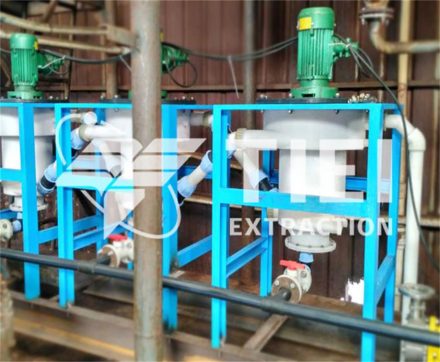
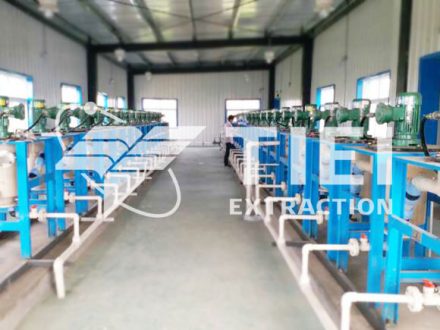
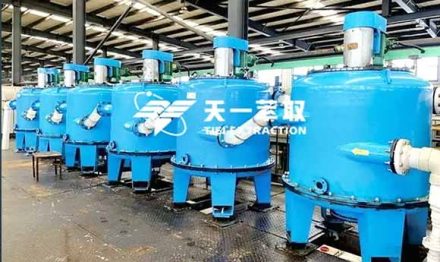
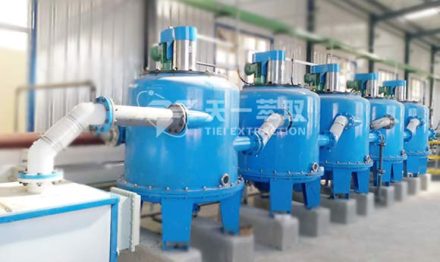
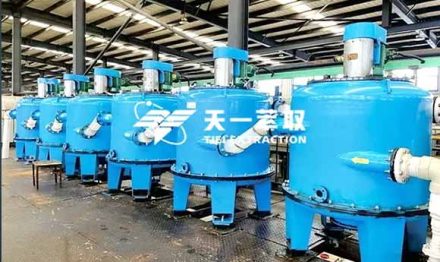
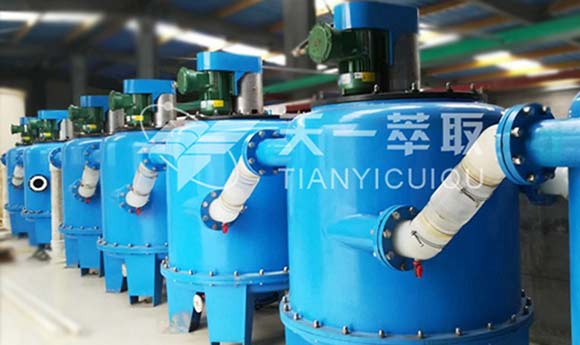
Under these conditions, Fe³⁺ is efficiently and selectively extracted into the organic phase, while Cr³⁺ and most of the other metal ions remain in the aqueous phase, i.e., the raffinate. To achieve the desired separation performance, a centrifugal extractor or mixer-settler can be selected as the core liquid-liquid extraction equipment. Compared with traditional equipment, a new high-efficiency centrifugal extractor offers the following significant advantages:
Significantly lower power consumption — Lower energy consumption under the same processing capacity.
Short residence time per stage — The material remains in the equipment for only a few seconds, helping to avoid emulsification and side reactions.
Rapid phase separation and high extraction efficiency — The two phases separate rapidly, which can significantly reduce the required number of stages.
Lower investment and operating costs — Compact equipment footprint, lower solvent entrainment losses, and reduced solvent regeneration costs.
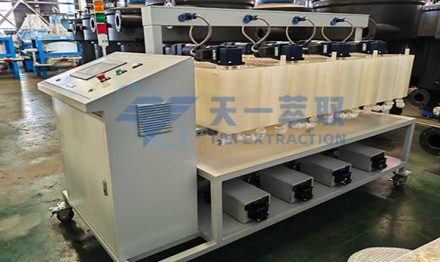
For feed systems where extraction performance is uncertain, it is recommended to first conduct laboratory-scale centrifugal extraction tests. By varying parameters such as the phase ratio, pH, and extractant concentration, the optimum number of stages and flow-rate ratio can be determined, providing reliable design data for industrial scale-up.
Stripping — Iron Recovery
The Fe³⁺-loaded organic phase needs to undergo stripping to regenerate the extractant and recover iron. In general, 5–8 mol/L hydrochloric acid is used as the stripping agent to strip Fe³⁺ from the organic phase into the aqueous phase, producing a high-concentration ferric chloride solution, which can be used as a coagulant for water treatment or further processed into iron salt products. After stripping, the organic phase can be washed with water and returned to the extraction stage for recycling, significantly reducing reagent consumption.
Precipitation Separation and Trivalent Chromium Recovery
The raffinate after iron removal mainly contains Cr³⁺, together with small amounts of impurities such as calcium, magnesium, and aluminum. At this stage, sodium hydroxide (NaOH) is used for stepwise precipitation. By strictly controlling the pH, Cr³⁺ is preferentially precipitated as chromium hydroxide, while the other metal ions remain in the solution. The resulting chromium hydroxide precipitate is filtered and washed, followed by acid dissolution, typically using sulfuric acid, to produce a relatively high-purity trivalent chromium salt solution, such as basic chromium sulfate. The recovered product can be reused in leather tanning or electroplating passivation processes, enabling the closed-loop recycling of chromium resources within the enterprise.
Overall Process Advantages and Equipment Selection
Through the process design of “heap leaching → extraction and iron removal → iron stripping → stepwise chromium precipitation,” this process achieves the following objectives:
Resource recovery — Chromium recovery can reach more than 90%, while iron is also effectively recovered and utilized.
Waste reduction — The final residue volume can be reduced by 60%–80% compared with the original sludge, while the residue is stabilized.
Environmental friendliness — No additional secondary wastewater is generated throughout the process, and the organic phase is recycled.
Economic feasibility — The recovered chromium and iron salts have market value and can offset part of the treatment costs.
For industrial equipment selection, factors such as processing capacity, feed solution characteristics, site conditions, and investment budget need to be considered comprehensively. For applications requiring high processing capacity and high phase ratios, multi-stage centrifugal extractor systems are generally superior to mixer-settlers because of their higher stage efficiency and lower solvent hold-up. For applications with smaller processing capacities or feed materials that are relatively easy to separate, mixer-settlers offer greater cost advantages. It is recommended that during the process development stage, laboratory-scale testing be conducted to obtain key parameters, such as the number of extraction stages, phase ratio, and mixing intensity, followed by pilot-scale validation. The optimal equipment configuration can then be determined based on the test results.
If you are developing a chromium-containing sludge resource recovery project, or wish to validate a solvent extraction process for a specific feed material, please feel free to contact our Tiei Extraction for customized laboratory testing support and engineering design services. Through scientific equipment selection and precise process control, solvent extraction technology can serve as a reliable solution for achieving both environmental compliance and economic benefits.
Email: sales@tieiextraction.com
Whatsapp: +86 19069612820