In liquid-liquid extraction, emulsification can be caused by surface-active substances, solid particles, or excessive agitation. In mild cases, it leads to slower phase separation and unclear phase interfaces. In more severe cases, it can interrupt extraction operations, increase solvent entrainment, and multiply the load on downstream processes.
Conventional methods such as heating, adding electrolytes, dosing demulsifiers, extending settling time, and centrifugal separation can be effective under specific operating conditions. However, they share a common limitation: they deal with emulsions that have already formed rather than preventing excessive emulsion formation inside the equipment in the first place. For systems with high concentrations of surface-active substances, shear-sensitive materials, or small density differences between the two phases, relying solely on downstream demulsification makes the process increasingly complicated and continuously increases operating costs.
An effective solution to emulsification in extraction should address the problem at an earlier stage: eliminate the conditions that generate excessively fine droplets before the materials enter high-shear zones.
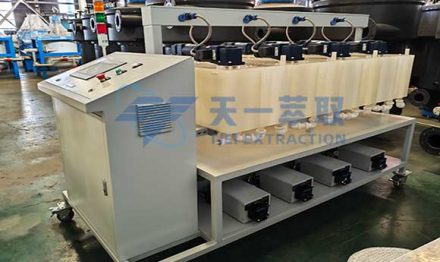
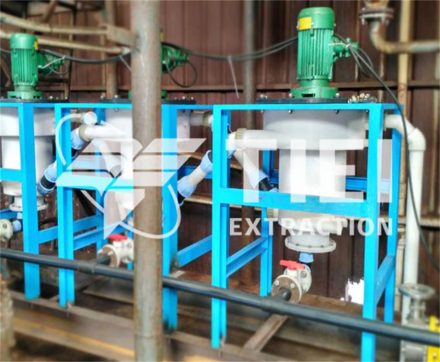
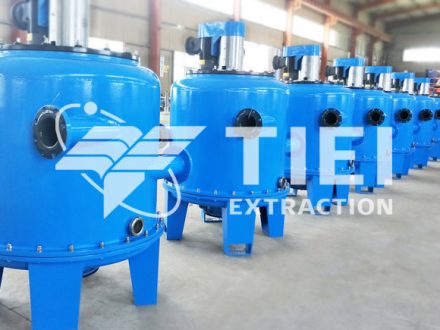
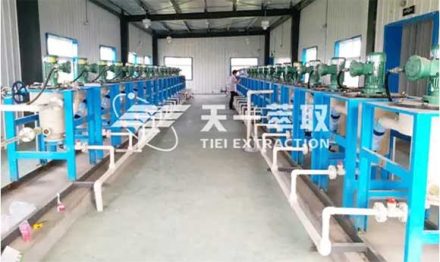
CWL-M Centrifugal Extractor: Integrating Emulsion Prevention into Equipment Design
One of the key differentiating features of the Tiei Extraction CWL-M Centrifugal Extractor is its design, which incorporates emulsion prevention directly into the equipment flow path.
1.Anti-Emulsification Sleeve and Static Mixing Zone
An anti-emulsification sleeve is installed between the rotating drum and the outer housing. The materials first enter a static mixing zone, where the two phases make gentle contact, avoiding direct impact against the high-speed rotating drum wall. The intense vortices commonly found in conventional annular-gap equipment are significantly reduced, lowering shear forces and minimizing the formation of excessively fine droplets. This helps suppress emulsification at the formation stage.
2.Optional Gentle Mixing Structure
For materials that are prone to emulsification, a gentler mixing mode can be selected. This maintains mass transfer efficiency while avoiding excessive emulsification, eliminating the need to compromise between insufficient mixing and low extraction efficiency on the one hand, and excessive mixing and uncontrolled emulsification on the other.
3.Compatibility with Conventional Demulsification Methods
The CWL-M Centrifugal Extractor does not exclude the use of auxiliary measures. Moderate heating, the addition of small amounts of electrolytes, or low-concentration demulsifiers can further destabilize residual droplets, enabling faster and more complete phase separation under the centrifugal field. By combining the equipment's emulsion prevention capabilities with chemical and thermodynamic methods, a multi-level solution to emulsification in liquid-liquid extraction can be achieved.
From Fine Chemicals to Hydrometallurgy: Where Has Its Emulsion Prevention Capability Been Applied?
1.Fine Chemicals and Pharmaceuticals
Fermentation broths contain proteins, sugars, and inorganic salts, making them highly susceptible to emulsification. Meanwhile, target products are often heat-sensitive and require continuous, enclosed operation. The CWL-M Centrifugal Extractor uses a centrifugal field instead of gravity settling, producing clearer boundaries between the aqueous phase, interfacial layer, and organic phase while reducing the accumulation of emulsion layers and mutual phase entrainment. In complex feed processes such as acid washing and alkali washing, the low-shear anti-emulsification sleeve can effectively alleviate entrainment and emulsification, supporting stable and continuous operation.
2.Hydrometallurgy
During the purification of nickel sulfate solutions, impurities such as copper, iron, and zinc need to be removed. The feed solution often contains trace amounts of organic extractants and surface-active substances, which can easily form emulsion layers in traditional equipment and lead to process interruptions. After adopting the CWL-M Centrifugal Extractor, emulsion layer formation is significantly reduced, extraction efficiency remains stable, and continuous operating cycles are extended. It supports multi-stage counter-current extraction while maintaining normal phase separation and preventing extractant emulsification.
3.Environmental Wastewater Treatment
Naphthenic acid wastewater has a complex composition, high COD levels, and severe emulsification problems. The CWL-M Centrifugal Extractor first uses a centrifugal field to achieve rapid mixing, mass transfer, and phase separation between wastewater and the extractant. Combined with extractant regeneration and biological treatment, the process can recover naphthenic acids while reducing COD and petroleum hydrocarbon content. In oil-water separation applications, the anti-emulsification sleeve also helps suppress vortices and turbulence in highly emulsified systems.
4.Other Proven Systems
Other applications include citric acid ester/water phase separation, where mixing and phase separation are completed within seconds, with single-stage extraction efficiency exceeding 95%; and toluene/hydrochloric acid systems, where phase separation is achieved within seconds under centrifugal fields of several thousand times gravity, eliminating emulsification and reducing solvent entrainment.
More Than Emulsion Prevention: Engineering Features for Stable and Continuous Operation
- Top-Suspended Single-Pivot Structure: No bottom bearings or mechanical seals in the processing zone, reducing leakage risks and equipment failure frequency.
- Low Power Consumption: Approximately 1/3 to 1/10 of that of traditional annular-gap models.
- Wide Processing Capacity Range: Covers applications from laboratory-scale testing to industrial-scale production.
- Fully Enclosed Continuous Operation: Reduces solvent volatilization and supports automated process control.
- Certifications and Explosion-Proof Options: ISO 9001 and CE certifications, with configurations available to meet explosion-proof requirements.
Emulsification problems cannot be solved with a one-size-fits-all set of operating parameters. They depend on the density difference between the two phases, the type and concentration of surface-active substances, the heat sensitivity of the target product, the existing mixing intensity and residence time, as well as the required processing throughput. The CWL-M Centrifugal Extractor provides fundamental equipment-level capabilities for suppressing emulsification. Auxiliary measures such as heating, electrolyte addition, and low-concentration demulsifiers can be flexibly combined according to the specific characteristics of each system.
Email: sales@tieiextraction.com
Whatsapp: +86 19069612820