Scandium is a silvery-white rare metal that plays an irreplaceable role in advanced fields such as aerospace, solid oxide fuel cells (SOFCs), metal halide lamps, and laser crystals. However, scandium is highly dispersed in nature and difficult to concentrate. Its recovery process is complex and costly, which has long been a challenge for the industry.
During the production of titanium dioxide, a large amount of waste acid is generated every year. The average scandium concentration in this waste acid is approximately 10–20 mg/L, making titanium dioxide waste acid an extremely valuable secondary resource rich in scandium. Therefore, how to efficiently and economically extract scandium from titanium dioxide waste acid has become a major focus of the industry.
Pain Points of Traditional Scandium Recovery Methods
At present, the main methods for recovering scandium from titanium dioxide waste acid include solvent extraction, solid adsorbent adsorption, liquid membrane extraction, precipitation, and other technologies. Among them, solvent extraction is widely used in the separation of rare metals due to its advantages of simple operation, low cost, and excellent separation performance.
However, traditional solvent extraction processes still face the problem of relatively low recovery rates in practical applications. The main reasons include:
1.Limited Extraction Efficiency:Traditional extraction equipment, such as mixer-settlers and extraction columns, requires relatively long contact times between the two phases. This can easily lead to emulsification, resulting in difficult phase separation and increased scandium loss.
2.Long Residence Time Between Stages: The prolonged residence time of materials inside the equipment not only affects processing efficiency but also increases the risk of degradation and side reactions.
3.High Solvent Loss: Traditional equipment often has high solvent entrainment, resulting in significant extractant losses and high solvent regeneration and recovery costs.
4.Low Efficiency in Multi-Stage Operations: To achieve higher recovery rates, multiple extraction stages are often required. However, as the number of stages increases, the overall efficiency of the system declines significantly.
These issues collectively restrict the final recovery rate of scandium and greatly reduce the economic viability of recovering scandium from titanium dioxide waste acid.
CWL-M Centrifugal Extractors: Solving the Problem of Low Recovery Rates
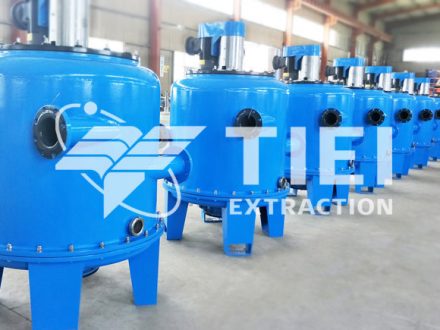
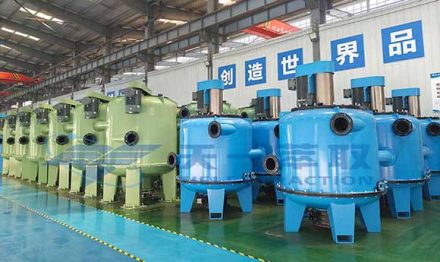
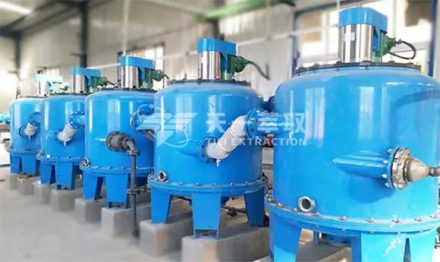
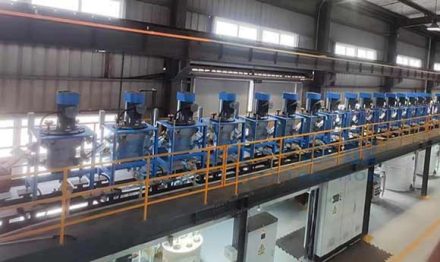
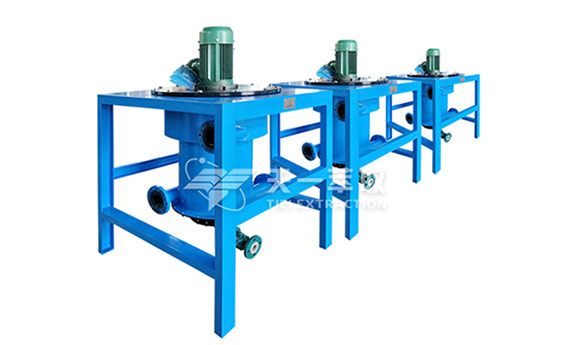
To address the recovery limitations of traditional methods, the CWL-M Series Centrifugal Extractor independently developed by Zhengzhou Tiei Extraction provides an efficient solution for scandium recovery from titanium dioxide waste acid with its innovative design concept and outstanding performance.
1.Short Residence Time Reduces Scandium Loss
The CWL-M centrifugal extractor uses high-speed centrifugal force to achieve rapid mixing and separation of the two liquid phases. The residence time of materials inside the equipment is extremely short, typically only a few seconds. This feature effectively avoids scandium losses caused by degradation, adsorption, or entrainment during the extraction process, significantly improving single-stage extraction efficiency.
2.Rapid Phase Separation Eliminates Emulsification Problems
Emulsification commonly occurs in traditional extraction equipment and can prevent clear phase separation, causing significant scandium losses through entrainment. With its powerful centrifugal force field, the CWL-M centrifugal extractor can rapidly and thoroughly separate systems with similar densities or strong emulsification tendencies. The phase interface remains clear and controllable, fundamentally eliminating recovery losses caused by emulsification.
3.High Extraction Efficiency with Excellent Multi-Stage Counter-Current Performance
The CWL-M centrifugal extractor can achieve a single-stage extraction efficiency of more than 95%, while maintaining stable stage efficiency. Through multi-stage counter-current operation, the overall recovery rate can easily surpass the limitations of traditional methods, enabling efficient enrichment of low-concentration scandium (10–20 mg/L) from titanium dioxide waste acid.
4.Reduced Solvent Consumption and Regeneration Costs
The equipment operates with extremely low solvent entrainment, which not only reduces the loss of expensive extractants but also lowers the workload and cost of solvent regeneration and recovery. From the perspective of overall process economics, the comprehensive operating cost of the CWL-M centrifugal extractor is significantly lower than that of traditional extraction equipment.
5.Fully Automated and Closed Operation for Highly Corrosive Environments
Titanium dioxide waste acid is characterized by strong acidity and high corrosiveness. The CWL-M centrifugal extractor is manufactured using high-quality corrosion-resistant materials, such as advanced polymer composite materials and Hastelloy alloys. The entire system can operate continuously in a fully automated and closed mode. The sealed design prevents acid mist emissions, ensuring operational safety while reducing material losses.
Scandium Recovery Process from Titanium Dioxide Waste Acid
The scandium recovery process from titanium dioxide waste acid using CWL-M centrifugal extractors is typically carried out according to the following steps:
- 1.Waste Acid Pretreatment: The titanium dioxide waste acid is first filtered to remove suspended solids, and the acidity is adjusted to the appropriate extraction range.
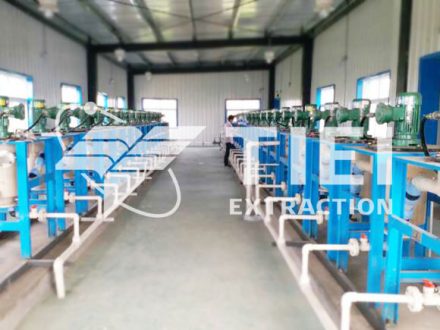
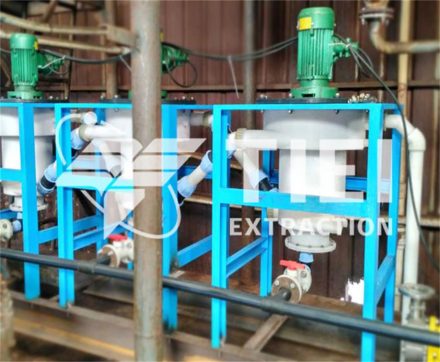
- 2.Multi-Stage Counter-Current Extraction: The pretreated waste acid and the organic phase containing the extractant are fed into a series-connected CWL-M centrifugal extraction system at a specified ratio. During the multi-stage counter-current extraction process, scandium in the waste acid is efficiently transferred into the organic phase. The raffinate (scandium-depleted waste acid) is discharged or sent to subsequent environmental treatment units.
- 3.Scrubbing and Stripping: The scandium-loaded organic phase enters the scrubbing section, where co-extracted impurity ions are removed. It is then contacted with a stripping agent, which transfers scandium from the organic phase back into the aqueous phase, producing a scandium-rich solution.
- 4.Post-Treatment: The scandium-rich solution undergoes subsequent processes such as precipitation and calcination to ultimately obtain high-purity scandium compounds or metallic scandium products.
Throughout the entire process, the CWL-M centrifugal extractor performs the core liquid-liquid separation functions, including extraction, scrubbing, and stripping. With its excellent mass transfer and phase separation performance, it ensures maximum recovery efficiency at every stage.
Customer Benefits: From Low Recovery to High Recovery
For titanium dioxide producers and scandium recovery companies, adopting CWL-M centrifugal extractors offers the following advantages:
- Significantly Improved Recovery Rate: The overall scandium recovery rate can be increased by 15%–30% compared with traditional processes, transforming valuable resources that would otherwise be lost into substantial economic returns.
- Reduced Operating Costs: Lower solvent consumption, a high degree of automation, and simplified maintenance significantly reduce the processing cost per ton of waste acid.
- Strong Process Adaptability: The system demonstrates excellent tolerance to fluctuations in scandium concentration and interference from impurities in waste acid, ensuring stable and reliable industrial-scale operation.
- Cleaner and More Environmentally Friendly: The closed operating system minimizes exhaust emissions, while the uniform acidity of the raffinate facilitates subsequent acid recovery or neutralization treatment.
Recovering scandium from titanium dioxide waste acid is not only an important technological challenge in rare-resource recovery but also a practical example of the circular economy in action. Although traditional solvent extraction technology offers theoretical advantages, its recovery rate has long been limited by equipment performance. The CWL-M centrifugal extractor developed by Zhengzhou Tiei Extraction provides the industry with a practical pathway toward higher recovery rates and lower operating costs through its core advantages of short residence time, rapid phase separation, and high extraction efficiency.
Email: sales@tieiextraction.com
Whatsapp: +86 19069612820