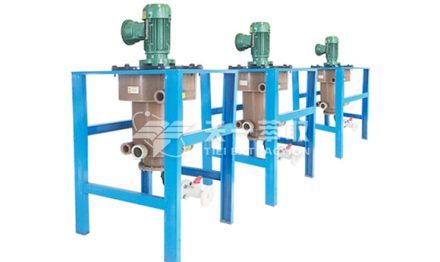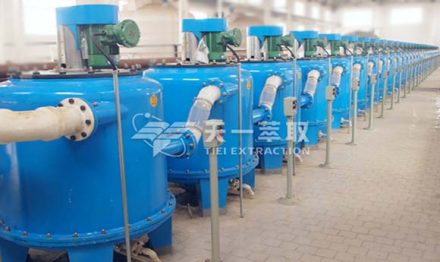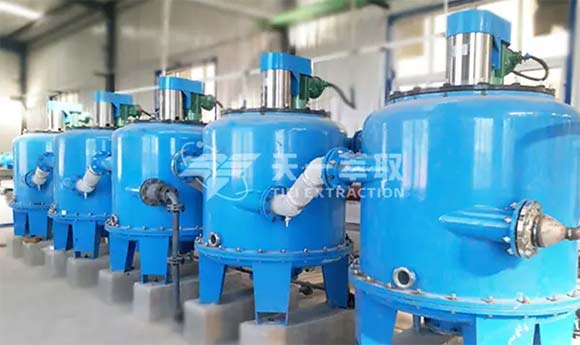
In the fields of hydrometallurgy and resource recycling, zinc-rich solutions are common process feed solutions with significant recovery value. They are widely derived from leachates of electroplating sludge, intermediate solutions from battery recycling, and acid leachates of smelting dust. Although these solutions have high zinc concentrations and relatively simple impurity compositions, traditional extraction equipment still faces challenges such as slow phase separation, a large number of stages, and solvent entrainment. Taking a zinc-rich solution treatment project at a certain enterprise as an example, Tiei Extraction introduces the process principles of zinc extraction using P204 and shares the engineering application of the CWL-M centrifugal extractor in this scenario.
Sources and Characteristics of Zinc-Rich Solutions
Zinc-rich solutions are typically derived from the acid leaching of zinc-containing waste materials. In one enterprise's case, the feed solution is based on a sulfuric acid system, with a pH of 3–4 and a daily processing capacity of 50 m³. The main metal concentrations are as follows: Zn 50 g/L, Ni 0.2 g/L, Cu 0.15 g/L, with Co and Mn present in trace amounts. The high zinc concentration and low impurity content provide significant recovery value. The process objective is to enrich zinc through extraction, followed by stripping and oil removal, to produce zinc sulfate products for further processing into zinc carbonate or electrolytic zinc.
Principles of Zinc Extraction Using P204
P204 (di(2-ethylhexyl) phosphoric acid) is an acidic organophosphorus extractant that exists in the form of dimers in the sulfuric acid system. Its mechanism for zinc extraction is a cation-exchange reaction: Zn²⁺(aq) + 2(HA)₂(org) ⇌ ZnA₂·2HA(org) + 2H⁺(aq). The reaction is controlled by pH. An increase in pH favors extraction, but an excessively high pH may lead to the co-extraction of other metal ions. Therefore, zinc extraction is generally carried out at a pH of 3–4, where P204 exhibits good selectivity for zinc, while most impurities such as nickel and cobalt remain in the aqueous phase.
After extraction, the loaded organic phase is washed to remove entrained impurities and then stripped with dilute sulfuric acid. Zinc is transferred from the organic phase back into the aqueous phase, producing a concentrated zinc sulfate solution. The organic phase is regenerated and recycled for reuse.
Process Compatibility of the CWL-M Centrifugal Extractor
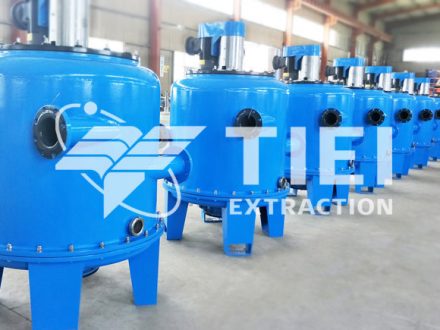
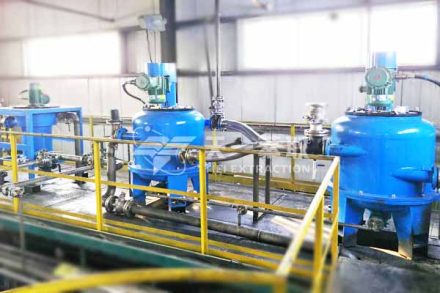
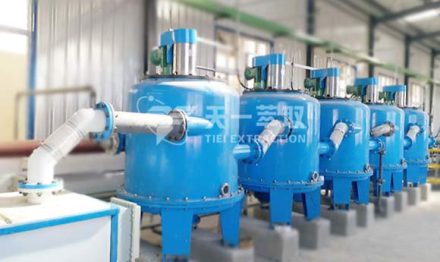
For this process, Tiei Extraction adopts a complete flowsheet consisting of 6 extraction stages, 3 washing stages, 5 stripping stages, and 2 regeneration stages. The CWL-M centrifugal extractor is highly compatible with this system due to the following characteristics:
1.Wide adaptability to different phase ratios
The zinc concentration is high, and the P204 loading capacity is substantial. The phase ratio in the extraction section may therefore be relatively low, while the phase ratio in the stripping section may increase significantly due to the larger volume of stripping agent required. The CWL-M centrifugal extractor supports a wide phase ratio range from 1:30 to 30:1, allowing the same equipment model to accommodate different process sections.
2.Efficient mass transfer and fewer stages
The CWL-M centrifugal extractor uses a centrifugal field of 800–1200 G to thoroughly mix the two phases at the micrometer scale. The interfacial area for mass transfer is increased by 5–8 times compared with traditional equipment, and the single-stage extraction efficiency is ≥90%. Efficient zinc enrichment can be achieved with only 6 extraction stages.
3.Phase separation within seconds and stable operation
Forced separation enables the two phases to separate clearly within 1–2 seconds. The organic-phase entrainment rate is less than 0.1%, preventing the accumulation of emulsion layers from interfering with continuous production.
4.Fully enclosed, corrosion-resistant design
As the feed solution is based on a sulfuric acid system, fluoropolymer materials can be selected for the equipment's wetted components. The fully enclosed structure prevents solvent volatilization and meets explosion-protection requirements.
Engineering Integration and Service Support
A complete extraction system includes feed pumps, flow meters, pressure sensors, piping, valves, control cabinets, and other components. Flow matching and pressure balance are maintained between the different process sections. The extractant saponification and regeneration systems are seamlessly integrated, while the stripped solution undergoes oil removal before entering subsequent precipitation and crystallization processes.
Tiei Extraction provides comprehensive services covering process design, equipment integration, installation, and commissioning, and can also conduct process validation using the customer's actual feed solution.
Email: sales@tieiextraction.com
Whatsapp: +86 19069612820