As the global transition toward electrification enters a critical stage, the installed capacity of power batteries continues to rise, and the “retirement wave” of spent batteries has become a reality rather than a forecast. Compared with primary mineral resources, the grades of valuable metals such as nickel, cobalt, manganese, and lithium in retired batteries can be several to dozens of times higher, making them a veritable “urban mine.” However, what truly constrains the large-scale expansion of the recycling industry is not a shortage of resources, but how to achieve closed-loop extraction of metals at lower cost, higher purity, and with greater environmental sustainability. This is becoming a key competitive battleground for the next stage of the new energy industry chain.
At present, hydrometallurgy has become the mainstream industrial recycling route due to its high metal recovery rates, high product purity, and strong process controllability. Within the entire hydrometallurgical process, the solvent extraction section directly determines metal separation efficiency, product quality, and operating costs, making it the “profit amplifier” of the entire production line. Traditional extraction equipment often faces challenges such as low stage efficiency, high solvent entrainment, large footprint, and limited flexibility, making it difficult to adapt to actual operating conditions characterized by significant variations in recycled feedstock composition and strong acid/alkali corrosion. In response, a new generation of process equipment centered on high-efficiency centrifugal extraction is opening up new possibilities for cost reduction and efficiency improvement.
How Does Centrifugal Extraction Reshape the Economics of Battery Recycling?
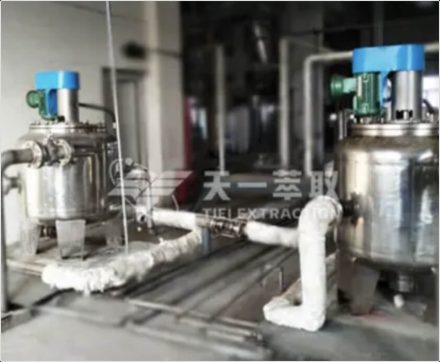
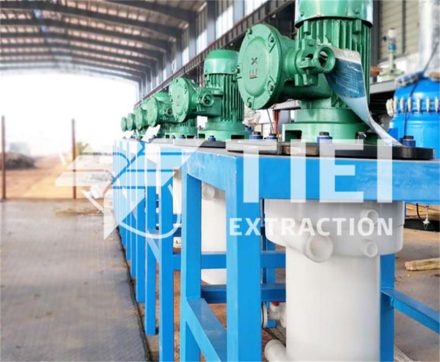
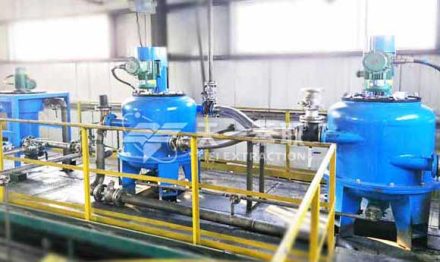
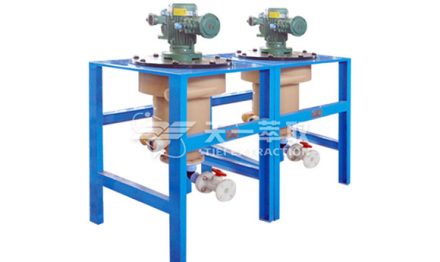
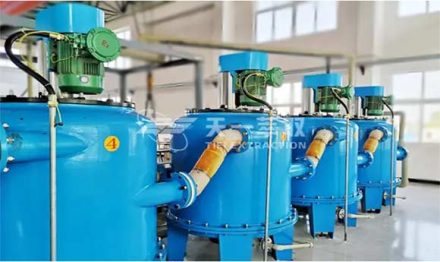
Taking the CWL-M series centrifugal extractor independently developed by Zhengzhou Tiei Extraction Technology Co., Ltd. as an example, the equipment utilizes the centrifugal force generated by high-speed rotation to achieve rapid two-phase mixing and fine phase separation. Compared with traditional gravity-settling extraction columns it can increase single-stage extraction efficiency to over 95% and reduce phase separation time to the order of seconds. Its core advantages include:
1.Compact Equipment and Flexible Adaptation
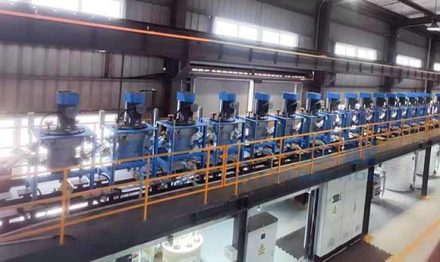
For the same processing capacity, a centrifugal extractor occupies only 1/5–1/10 of the floor space required by a traditional mixer-settler. It also offers strong processing flexibility, enabling recycling companies to adjust production line loads according to fluctuations in retired battery feedstock.
2.Extremely Low Solvent Entrainment and Loss
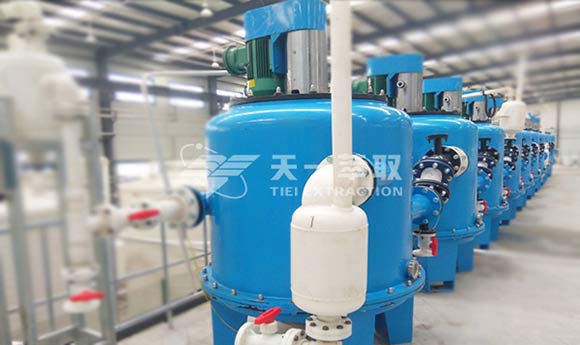
The fully enclosed structure not only significantly reduces the volatilization of organic solvents, but also controls solvent residues in the raffinate to the ppm level. This substantially reduces the pressure on subsequent wastewater treatment and directly lowers environmental operating costs.
3.Strong Corrosion Resistance and Long-Term Stable Operation
Depending on harsh operating conditions such as strongly acidic leachates, high chloride concentrations, and high salinity, the wetted components of the equipment can be manufactured from special alloys or polymer composite materials. This ensures a service life of more than 10 years under continuous operation while significantly reducing maintenance frequency.
4.Precise Stage Configuration and Consistent Stripping Quality
Through a counter-current multi-stage design with adjustable numbers of stages, stable separation factors can be maintained during the stepwise extraction of elements such as cobalt, nickel, and lithium. The stripped solution contains low levels of impurities and can directly meet the requirements of downstream battery precursor or cathode material production, reducing the need for secondary purification.
From Laboratory Testing to Industrial-Scale Implementation
For newly built or upgraded battery recycling production lines, Tiei Extraction provides full-chain support covering laboratory testing, pilot testing, and industrial scale-up.
Through the CWL50-M laboratory unit, key design parameters such as phase ratio, rotational speed, and number of stages can be obtained rapidly. Based on these parameters, an industrial model ranging from CWL250-M to CWL900-M can then be accurately selected, helping mitigate scale-up risks. This solution has already been industrially validated in multiple battery recycling projects. The data show that, at the same processing capacity, the overall operating cost of the centrifugal extraction process—including reagent consumption, energy consumption, and waste-liquid treatment—can be reduced by 15%–25% compared with traditional extraction processes, while direct metal recovery can be increased by 1–3 percentage points. In an environment of volatile metal prices, this translates into significant additional profit potential.
A Green and Compliant Choice for the Global Market
As the EU’s New Batteries Regulation imposes mandatory requirements on the utilization of recycled materials and carbon footprint traceability becomes increasingly stringent, low-carbon, enclosed, and intelligent recycling processes are becoming essential for export-oriented companies.
Centrifugal extraction equipment operates in a fully enclosed manner, significantly reducing fugitive emissions. In addition, its electricity consumption per unit of processing capacity is only 60%–70% that of traditional mixer settlers. This not only aligns with ESG investment preferences, but also helps export-oriented companies overcome environmental barriers in international markets.
Email: sales@tieiextraction.com
Whatsapp: +86 19069612820