As one of the most widely used organic acids worldwide, citric acid plays an indispensable role in food, pharmaceuticals, personal care, industrial cleaning, and other fields. As end markets continue to raise their requirements for product purity, production sustainability, and cost control, the core competitive focus of citric acid manufacturers has shifted from upstream fermentation capacity to the technical efficiency of downstream separation and purification. How to build a low-consumption, high-efficiency, environmentally friendly, and economically viable extraction and purification production line has become a common technical challenge for citric acid manufacturers worldwide.
Downstream Purification: The Value Center of Citric Acid Production
At present, citric acid fermentation technology has become highly mature and standardized. The real process challenges are concentrated in the downstream treatment of fermentation broth—namely, the separation, concentration, and purification of the target product. This stage directly determines the final product yield, quality grade, and environmental compliance costs of the plant. Looking at the mainstream extraction routes used internationally, there are significant differences among the various technologies:
Calcium Salt Precipitation: Although this is a classic process that has been used in the industry for many years and offers a high degree of process reliability, it involves a long process flow and numerous operating units. It also generates large amounts of solid waste and acidic wastewater, making it increasingly restricted under stricter environmental regulations.
Ion Exchange: This method can avoid the generation of calcium salt waste and offers a relatively simplified operation with acceptable yield performance. However, resin regeneration consumes large quantities of chemical reagents and produces high-salt wastewater. In addition, frequent resin replacement leads to relatively high operating costs.
Liquid Membrane: This technology offers advantages such as rapid mass transfer and membrane-phase reuse. However, liquid membrane systems have relatively poor stability and involve toxic surfactants, making it difficult to meet the safety requirements for food- and pharmaceutical-grade production.
Solvent Extraction: With its inherent advantages of continuous operation, extractant recycling and regeneration, zero solid waste generation, and high separation efficiency, solvent extraction is widely recognized as one of the most promising green extraction technologies for industrial applications. Its core lies in establishing an efficient two-phase contacting and separation system, which makes equipment selection a critical factor.
Breakthrough in Core Equipment: How Centrifugal Extractors Reshape Extraction Efficiency
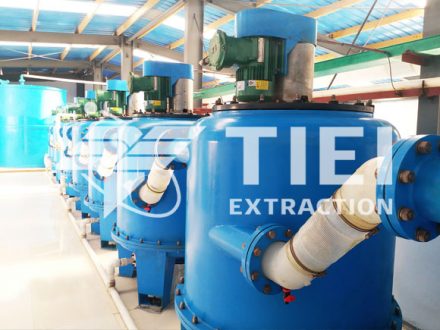
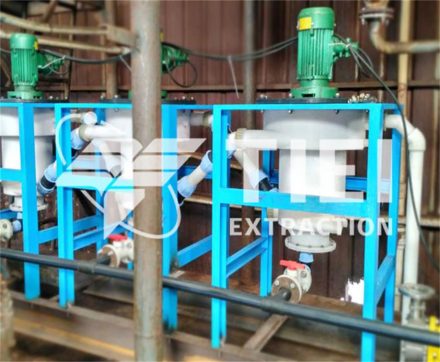
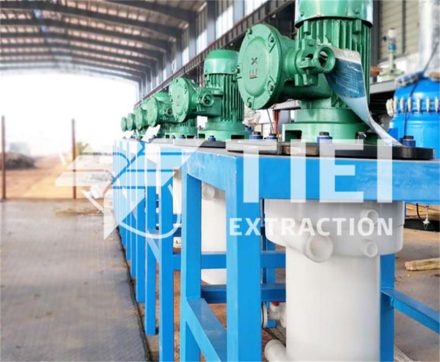
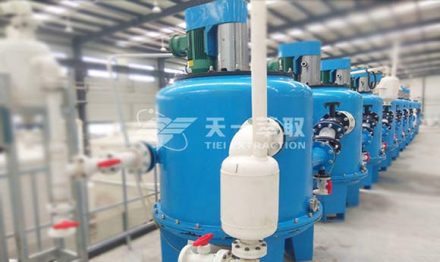
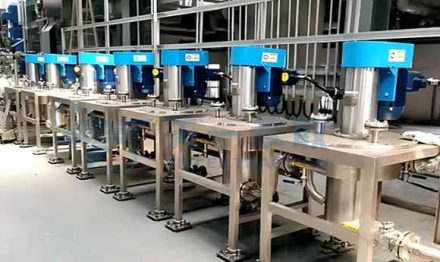
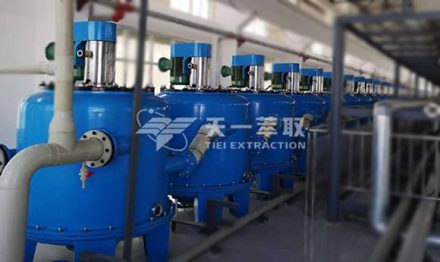
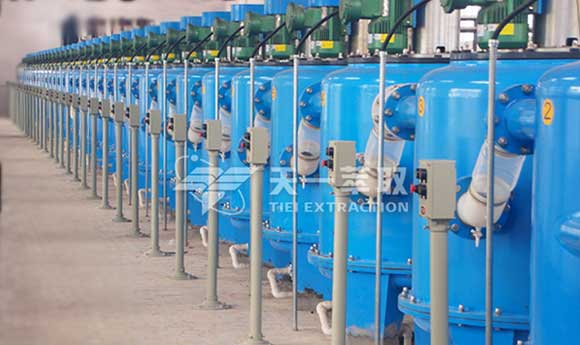
In the industrial implementation of solvent extraction, traditional mixer-settlers or extraction columns often face challenges such as low stage efficiency, significant solvent entrainment, and a pronounced tendency toward emulsification. The CWL-M Series Centrifugal Extractor developed by Zhengzhou Tiei Extraction Technology Co., Ltd. provides a new equipment-level solution for citric acid extraction processes.
The equipment utilizes the centrifugal force generated by high-speed rotation to achieve high-intensity, high-density turbulent mixing of the light and heavy phases inside the rotor, followed by rapid phase separation under centrifugal force. Its technical advantages include:
1.High stage efficiency: The single-stage extraction rate can reach 49%. With 3–5 stages connected in counter-current configuration, the total extraction rate remains above 99.3%, ensuring near-complete recovery of citric acid from the fermentation broth.
2.Rapid phase separation and low solvent holdup: The short contact time between the two phases effectively reduces extractant degradation and side reactions while lowering the initial solvent filling cost.
3.Fully enclosed operation: The closed operating system prevents the release of volatile organic compounds, significantly improving the working environment and meeting high EHS (Environment, Health, and Safety) requirements.
4.Flexible adaptability: For projects involving fluctuations in feed-liquid properties or requiring new process verification, we provide the CWL50-M laboratory-scale centrifugal extractor. It can simulate industrial-scale counter-current extraction performance during laboratory or pilot-scale testing and rapidly obtain key parameters, such as phase ratio, number of stages, pH, and temperature, providing reliable data for industrial scale-up.
Complete Process Solution: Optimizing the Entire Extraction-to-Stripping Chain
Based on the CWL-M Centrifugal Extractor, Zhengzhou Tiei Extraction Technology has developed a streamlined and highly efficient citric acid extraction process:
1.Preparation of a dedicated extractant: n-Dodecyl tetradecylamine + methyl isobutyl ketone (MIBK) are used as the primary extraction system, with sec-octanol added as a phase modifier to improve emulsion resistance and extraction selectivity.
2.Counter-current extraction: The acidified citric acid solution and extractant are brought into counter-current contact in the centrifugal extractors. After multiple stages of series connection, citric acid is transferred into the organic phase, while the raffinate containing residual sugars, proteins, and other components can be directly sent to subsequent anaerobic treatment without neutralization or precipitation.
3.Counter-current stripping: The loaded organic phase and purified water undergo multi-stage counter-current contact in another group of centrifugal extractors at an optimized ratio. The single-stage stripping rate can reach 78.6%. After 2–3 stages of counter-current stripping, the overall stripping recovery of citric acid into the aqueous phase can reach as high as 99.9%, producing a high-purity citric acid solution that can be directly sent to the crystallization process.
4.Extractant regeneration: After stripping, the organic phase is simply washed and recycled. The entire process generates no waste acid, solid waste, or calcium sulfate by-products, significantly reducing end-of-pipe treatment costs.
Data Support and Industrial Reliability
Verified by multiple industrial-scale installations, this integrated process can achieve:
Total recovery (extraction + stripping) >99%, significantly higher than the upper limit of traditional calcium salt processes;
Extractant loss <0.5% (based on circulation volume), keeping operating costs under control;
Key product quality indicators, including color, transmittance, and sulfated ash, meet international standards such as USP, BP, and FCC.
For projects with uncertain process conditions or special feed-liquid compositions, Zhengzhou Tiei Extraction Technology provides full-cycle technical services covering laboratory-scale testing → pilot-scale validation → industrial process design → equipment integration → commissioning and start-up.
If you are planning a new citric acid production line or looking to upgrade an existing calcium salt or ion-exchange process toward a greener production model, please feel free to contact us. We are committed to helping you achieve a win-win outcome between economic performance and environmental responsibility through precise extraction and separation technology.
Email: sales@tieiextraction.com
Whatsapp: +86 19069612820