Xylene is a product in which two hydrogen atoms on the benzene ring are replaced by methyl groups. It exists in three isomers: ortho-xylene, meta-xylene, and para-xylene, and industrially, the term “xylene” generally refers to a mixture of these three isomers. In chemical production, the separation of xylene from water is a common process. Since xylene is poorly soluble in water and its density is generally lower than that of water, theoretical separation can be achieved through settling and phase stratification. However, in actual feed liquids, the presence of surfactants, emulsifiers, fine particles, reaction by-products, and other substances can easily result in slow phase separation, severe phase entrainment, and stable emulsions. Therefore, selecting highly efficient liquid-liquid extraction and separation equipment is essential.
Solvent extraction is a commonly used technical approach for xylene-water separation. This method uses a specific extractant to thoroughly mix the feed liquid with the extractant, transferring target components such as xylene from the aqueous phase to the extractant phase, followed by phase separation. Its advantages include a simple process, good separation performance, high processing capacity, and relatively controllable extractant costs with the possibility of recycling and reuse. For aqueous phases containing trace amounts of xylene, solvent extraction can effectively recover organic compounds. For applications requiring continuous processing, centrifugal extractors offer greater advantages than traditional mixer settlers and extraction columns.
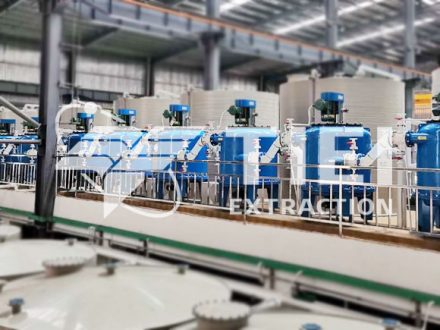
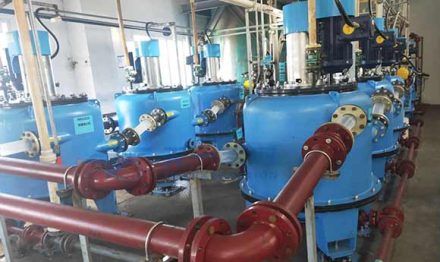
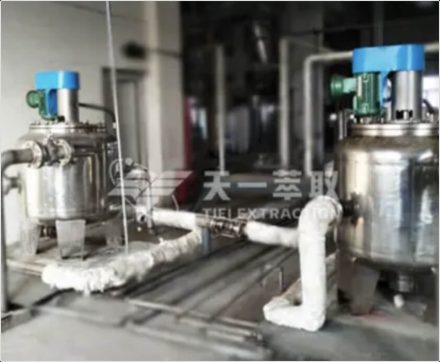
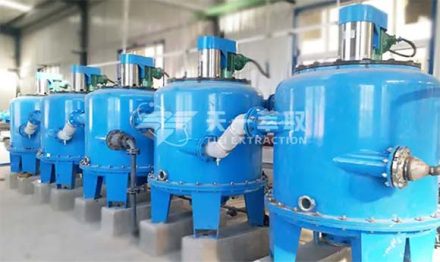
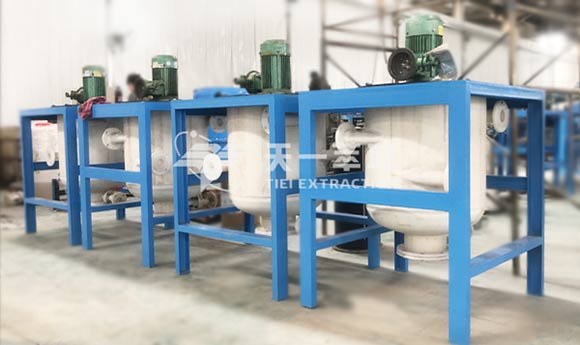
The CWL-M Centrifugal Extractor uses centrifugal force to achieve rapid mixing and separation of the two phases. During operation, the aqueous phase and organic phase enter the mixing zone at a specified phase ratio. Under high-speed shearing and turbulent conditions, the two phases undergo thorough mass transfer. The resulting mixture then enters the separation zone of the rotating drum, where the two phases rapidly separate according to their density difference under the centrifugal force field. The light phase and heavy phase are discharged separately through their respective outlets. Through multistage series connection, continuous operations such as counter-current extraction, washing, and stripping can also be achieved.
In xylene-water separation, a typical process using the CWL-M Centrifugal Extractor includes:
Feed Pretreatment: Depending on the water quality and organic-phase composition, pretreatment such as filtration, temperature adjustment, or demulsification is carried out.
Extraction and Mixing: The aqueous phase and extractant enter the CWL-M Centrifugal Extractor at a specified phase ratio, allowing xylene to transfer into the organic phase.
Centrifugal Separation: Centrifugal force is used to rapidly separate the two phases, reducing phase entrainment and the effects of emulsification.
Washing: When necessary, the organic phase is washed to remove entrained water-soluble impurities.
Stripping or Distillation: Xylene and the extractant are recovered, and the extractant is recycled for reuse.
Aqueous-Phase Treatment: The separated aqueous phase is sent to subsequent treatment or reuse processes according to specific requirements.
Compared with traditional mixer settlers and extraction columns, the CWL-M Centrifugal Extractor offers the following features:
1.High processing capacity, suitable for continuous industrial production.
2.Low power consumption and controllable overall operating costs.
3.Excellent separation performance, significantly reducing phase entrainment.
4.Enclosed operation, minimizing volatilization and material loss.
5.Compact footprint, facilitating integration into existing production lines.
6.Supports continuous extraction, washing, stripping, and other operations.
7.Strong adaptability to easily emulsified systems, with faster phase separation.
8.Multistage series connection can be used to improve recovery rate and product purity.
Frequently Asked Questions
1.Is an extractant always required for xylene-water separation?
Not necessarily. If the objective is simply to separate two phases by settling, centrifugal separation can be used directly. If trace amounts of xylene in water need to be recovered, or if the system is prone to emulsification, solvent extraction combined with a centrifugal extractor can be adopted.
2.Can the CWL-M Centrifugal Extractor handle emulsions?
It can enhance phase separation. However, when emulsification is severe, pretreatment such as demulsification may be required, or equipment selection and process parameters can be adjusted to improve separation performance.
3.How is the number of extraction stages determined?
It should be determined based on the distribution coefficient, phase ratio, target recovery rate, and feed composition through laboratory or pilot-scale testing. Direct scale-up based solely on experience is not recommended.
4.Can the equipment operate continuously?
Yes. The CWL-M Centrifugal Extractor supports continuous feeding and continuous separation, and can be configured into multistage counter-current extraction, washing, and stripping systems.
Conclusion
The CWL-M Centrifugal Extractor integrates mixing and mass transfer with centrifugal separation, effectively addressing issues such as slow phase separation, excessive phase entrainment, and easy emulsification in xylene-water separation. For chemical separation applications requiring continuous operation, large-scale processing, and low operating costs, the CWL-M Centrifugal Extractor is a liquid-liquid extraction solution worthy of evaluation. Tiei Extraction can provide equipment selection recommendations and testing support based on specific material systems.
Email: sales@tieiextraction.com
Whatsapp: +86 19069612820