Dihydroxybenzene has three isomers: catechol, resorcinol, and hydroquinone. They are widely used in pharmaceutical intermediates, pesticide synthesis, rubber antioxidants, dyes, photographic materials, and other fields. Due to the extremely similar physicochemical properties and close boiling points of these three isomers, traditional distillation methods not only consume large amounts of energy but also make it difficult to achieve high-purity separation. Therefore, liquid-liquid extraction technology has become a mainstream industrial method for the extraction and separation of Dihydrobenzene isomers due to its advantages of high selectivity, high mass transfer efficiency, and mild operating temperature conditions.
Core Process Flow of Liquid-Liquid Extraction
The liquid-liquid extraction process for extracting dihydroxybenzene generally includes the following key steps:
1.Feed Preparation: The mother liquor or reaction solution containing dihydroxybenzene is adjusted to an appropriate pH value, and suspended solids are removed through filtration to ensure clean feed conditions.
2.Selection of Extractant: According to the distribution coefficients of the target dihydroxybenzene isomers, suitable organic solvents (such as esters, ketones, or composite extractants) are selected to form an immiscible two-phase system with the aqueous phase.
3.Mixing and Mass Transfer: The feed solution (aqueous phase) and extractant enter the extraction equipment simultaneously at a certain ratio. Through intensive mixing, dihydroxybenzene is transferred from the aqueous phase to the organic phase, completing interphase mass transfer.
4.Two-Phase Separation: Utilizing the density difference between the aqueous phase and organic phase, rapid phase separation is achieved under gravity or centrifugal force, obtaining the loaded organic phase and raffinate aqueous phase.
5.Stripping and Solvent Recovery: The loaded organic phase undergoes stripping treatment, transferring dihydroxybenzene into the aqueous phase, or directly proceeding to subsequent distillation and purification. The extractant is recycled for reuse.
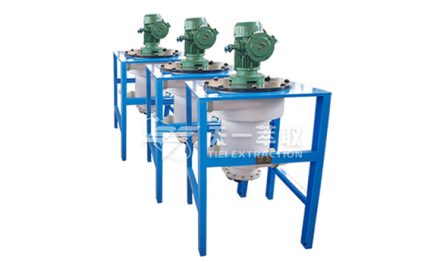
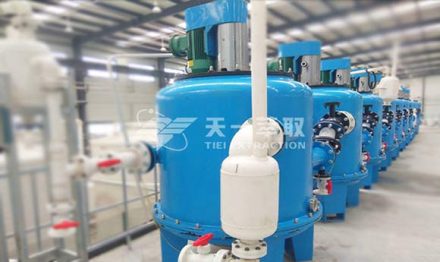
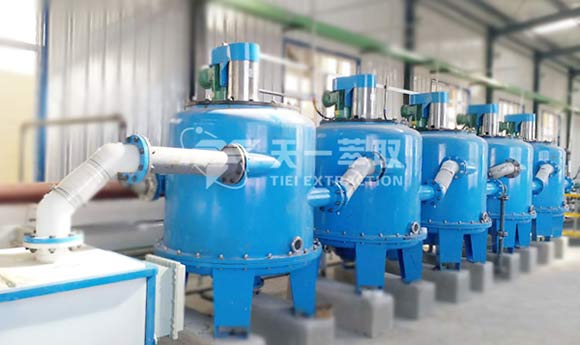
The entire process requires equipment with efficient mixing, rapid separation, and continuous stable operation capabilities. The CWL-M centrifugal extractor is an ideal core equipment that fully meets these requirements.
CWL-M Centrifugal Extractor: Technical Principle and Structural Advantages
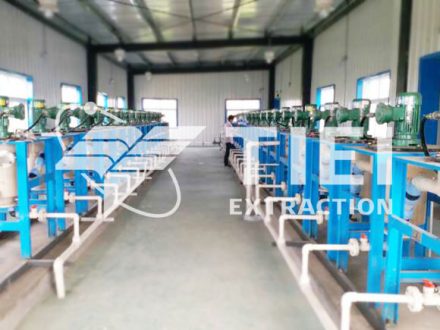
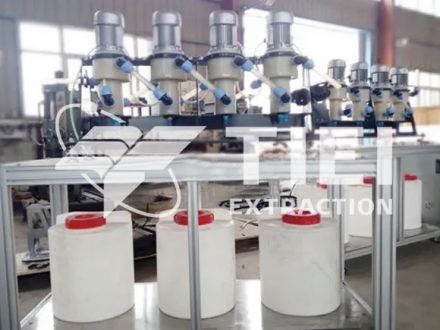
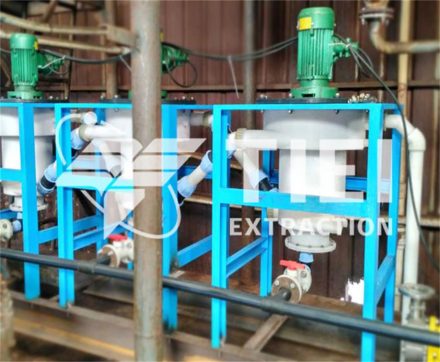
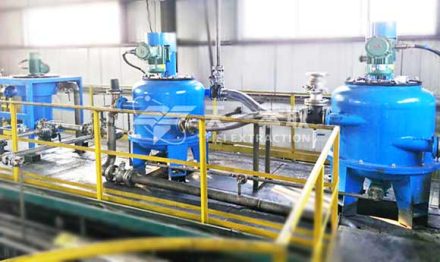
The CWL-M series centrifugal extractor is a new-generation liquid-liquid extraction and separation equipment independently developed by Zhengzhou Tiei Extraction Technology Co., Ltd. The equipment mainly consists of a rotor, housing, feeding system, mixing mechanism, and other components. Its working principle is as follows:
The feed solution containing dihydroxybenzene and the extractant are simultaneously introduced into the mixing zone inside the rotor.
The high-speed rotating drum generates a powerful centrifugal force field. The two liquid phases are subjected to intense shearing and turbulent mixing in the mixing zone, forming fine droplets. This greatly increases the interfacial contact area and enables rapid transfer of dihydroxybenzene.
The mixed liquid then enters the separation zone, where the two phases rapidly separate due to their density difference under centrifugal force. The heavy phase (aqueous phase) and light phase (organic phase) are continuously discharged through their respective flow channels, achieving uninterrupted dihydroxybenzene extraction and separation.
Outstanding Advantages of CWL-M Centrifugal Extractor Compared with Traditional Extraction Equipment
Compared with traditional mixer settlers or extraction columns, the CWL-M centrifugal extractor demonstrates significant improvements in multiple aspects:
1.Separation Efficiency: Traditional equipment relies on gravity settling, resulting in slow separation speed and relatively low stage efficiency. The CWL-M centrifugal extractor utilizes a centrifugal force field, with centrifugal acceleration reaching hundreds of times that of gravity. This greatly shortens the phase separation time and significantly improves stage efficiency.
2.Processing Capacity and Space Utilization: Traditional extraction equipment is usually large in size and has limited processing capacity per unit volume. The CWL-M centrifugal extractor adopts a compact design, providing high processing capacity while occupying only one-fifth to one-tenth of the installation area required by traditional equipment, greatly saving plant space.
3.Operational Stability and Anti-Emulsification Performance: Traditional equipment is prone to emulsification, phase entrainment, and unstable operating conditions during operation. The CWL-M centrifugal extractor operates in a closed system, offering strong resistance to emulsification and a wide operating range. Even under fluctuations in flow rate and phase ratio, it can maintain stable separation performance.
4.Solvent Consumption and Operating Cost: Traditional equipment generally requires a higher phase ratio, resulting in greater solvent loss. The CWL-M centrifugal extractor can significantly reduce the phase ratio, minimize solvent entrainment, effectively reduce extractant consumption, and lower long-term operating costs.
5.Convenient Maintenance and Cleaning: Traditional equipment has complex internal structures, making cleaning and maintenance time-consuming and labor-intensive. The CWL-M centrifugal extractor adopts a modular design, allowing easy disassembly and assembly, facilitating routine maintenance and internal cleaning.
6.Continuous Operation and Automation: Traditional mixer settlers are often operated intermittently or semi-continuously with a low level of automation. The CWL-M centrifugal extractor supports fully continuous feeding and discharge and can be easily integrated with DCS control systems to achieve intelligent production management.
In addition, the material of the CWL-M centrifugal extractor can be customized according to the corrosiveness of the feed solution, including stainless steel, titanium, Hastelloy alloy, and other materials. This enables reliable long-term operation in various chemical environments.
Conclusion
In the industrial production of dihydroxybenzene isomer extraction, selecting extraction equipment that is efficient, energy-saving, stable, and easy to maintain is the key to improving enterprise competitiveness. With its outstanding technical advantages, the CWL-M centrifugal extractor brings new possibilities to liquid-liquid extraction processes, helping customers achieve lower costs, higher purity, and greener production goals for dihydroxybenzene.
Zhengzhou Tiei Extraction Technology Co., Ltd. has been dedicated to the research and manufacturing of liquid-liquid extraction separation technology and equipment for many years. The CWL-M series centrifugal extractor has been widely applied in fine chemicals, hydrometallurgy, pharmaceuticals, environmental protection, and other industries. With excellent performance, reliable quality, and professional technical services, the company has earned the trust of customers worldwide.
Email: sales@tieiextraction.com
Whatsapp: +86 19069612820