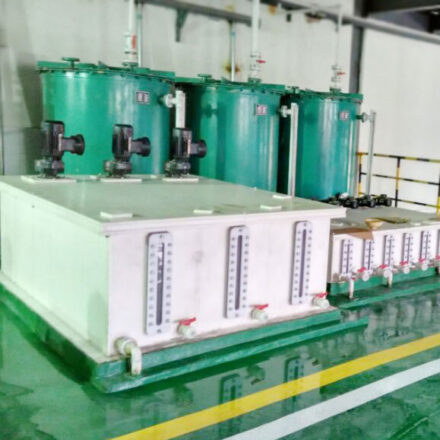
The core challenge in heavy metal wastewater treatment is not simply whether metal ions can be removed, but whether solvent consumption, footprint, phase separation stability, and metal recovery value can be achieved simultaneously. Chemical precipitation transfers heavy metals into sludge, changing their physical form without realizing resource recovery. Solvent extraction, on the other hand, takes advantage of the distribution differences of target metal ions between the organic and aqueous phases to selectively enrich and recover metals through stripping, giving wastewater treatment an added resource recovery function. Whether the extraction process can operate stably over the long term depends largely on equipment selection.
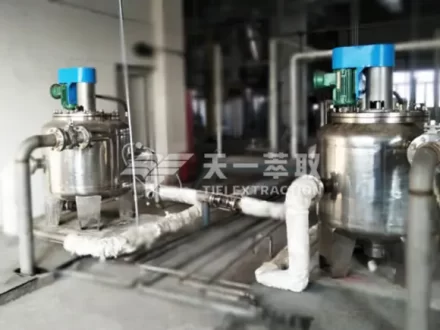
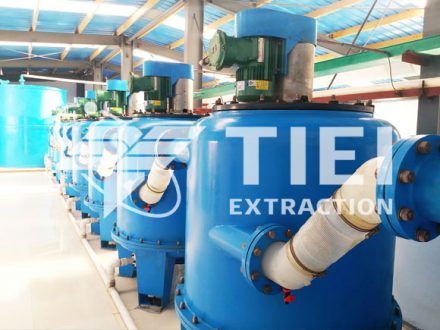
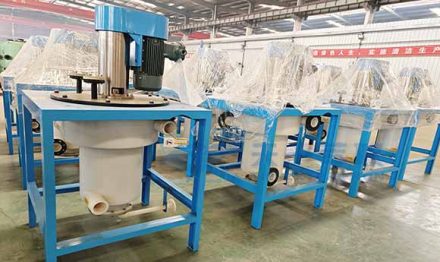
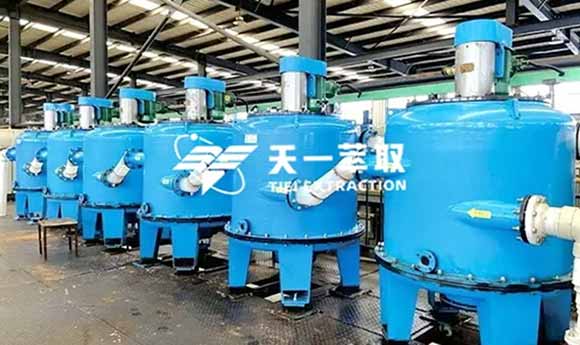
The CWL-M Centrifugal Extractor uses the centrifugal force generated by high-speed rotation instead of the gravitational field relied upon by traditional mixer-settlers. It integrates mixing, mass transfer, and phase separation into a process completed within seconds. This provides a practical operating window for treating heavy metal wastewater under conditions where traditional gravity-based equipment struggles to operate reliably, such as insufficient density differences between phases, easy emulsification, and severe phase entrainment.
How the CWL-M Centrifugal Extractor Overcomes the Limitations of Traditional Extraction Equipment
Traditional mixer-settlers rely on gravity for phase separation. When the specific gravity difference between the two phases is less than 0.1, separation efficiency decreases significantly. In easily emulsified systems, the accumulation of interfacial contaminants leads to continuously worsening organic phase entrainment. The technical principle of the CWL-M Centrifugal Extractor is not simply to "accelerate phase separation," but to fundamentally change the conditions for phase separation through a different physical field:
1.Expanded Applicable Range of Phase Density Differences: The CWL-M centrifugal extractor can handle a specific gravity difference between the two phases of ≥0.03, significantly lower than the typical minimum requirement of 0.1 for mixer-settlers. For heavy metal wastewater containing organic matter, surfactants, or high salt concentrations that reduce the density difference between phases, this parameter directly determines process feasibility.
2.Extremely Short Residence Time: Mixing, mass transfer, and phase separation are completed within seconds inside each unit. For systems involving easily degradable extractants and continuous operation under frequently fluctuating water quality conditions, shorter residence times mean lower solvent degradation losses and faster recovery of steady-state operation.
3.Reduced Organic Phase Entrainment and Improved Extraction Efficiency: Organic phase entrainment is reduced by 60%, while extraction efficiency increases by 5%–8% (engineering data from hydrometallurgical metal recovery applications). Reduced entrainment directly lowers solvent replenishment costs, while also decreasing the impurity load in the stripping solution and reducing the burden on downstream processes.
4.Significantly Reduced Footprint: Under the same processing capacity, the required floor space is approximately one-tenth that of traditional mixer-settlers. For retrofit projects where no additional space has been allocated for an extraction section, this factor often carries greater decision-making weight than equipment price.
5.Lower Power Consumption: Power consumption is only 10%–30% of that of conventional annular-gap traditional extractors under the same processing capacity conditions.
Reliable Structural Design of the CWL-M Centrifugal Extractor
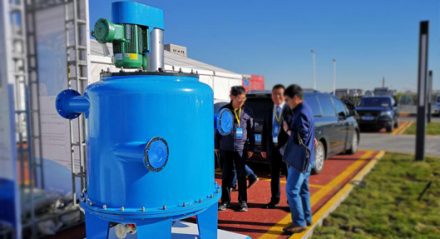
The CWL-M Centrifugal Extractor adopts an upper-suspended, single-support-point structure, eliminating the bottom bearing and mechanical seal from the processing area. This design directly addresses two common failure modes of traditional centrifugal extractors: bottom seal leakage and bearing corrosion. By eliminating the bottom mechanical seal from the processing area, the risk of leakage is eliminated at the structural level rather than being controlled through maintenance frequency.
In terms of materials, the CWL-M centrifugal extractor can be constructed using 316L stainless steel, 2205 duplex stainless steel, and fully fluorinated polymer materials, among other options, covering applications ranging from acidic to highly corrosive liquid systems. For heavy metal wastewater containing chloride ions, fluoride ions, or low-pH solutions, proper material selection is a prerequisite for ensuring equipment service life.
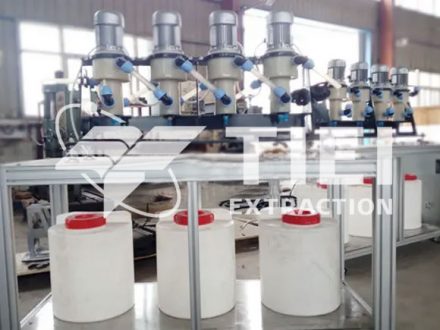
The processing capacity covers a complete range from the laboratory-scale CWL50-M (5–50 L/h) to the industrial-scale CWL650-M (10,000–60,000 L/h). Pilot-scale models, including the CWL150-M, CWL350-M, and CWL450-M, can directly use actual process solutions to validate multi-stage counter-current extraction processes. The equipment scale can then be expanded linearly according to the verified number of stages and processing capacity, reducing the engineering risks associated with processes that are feasible at laboratory scale but fail during scale-up.
Process Performance of the CWL-M Centrifugal Extractor in Heavy Metal Wastewater Treatment
The CWL-M Centrifugal Extractor provides an integrated operating platform covering the three core process stages of extraction, washing, and stripping. Reproducible process routes have been established for various heavy metal wastewater systems:
Nickel-containing Electroplating Wastewater: A synergistic extraction system using D2EHPA and MIBK is employed. Under the centrifugal force field of the CWL-M Centrifugal Extractor, nickel ions are transferred from the aqueous phase to the organic phase. The loaded organic phase is then stripped with an acid solution to obtain a nickel-containing recovery solution. The nickel removal rate can reach over 93%, with the raffinate meeting discharge requirements. The stripping solution can be returned directly to the production system or further refined.
Manganese-containing Wastewater: After multi-stage counter-current extraction using the CWL-M Centrifugal Extractor, the manganese concentration in the raffinate can be controlled below 0.1 mg/L. The loaded organic phase is stripped to obtain a high-purity manganese sulfate solution.
Zinc-Iron Separation: The high-speed centrifugal force field of the CWL-M Centrifugal Extractor addresses the problems of incomplete zinc-iron separation and severe phase entrainment commonly encountered with mixer-settlers. Zinc recovery can reach over 99.9%.
Arsenic-containing Smelting Wastewater and Chromium-containing Electroplating Wastewater: By matching the process with appropriate extractant systems, these applications can also be incorporated into the CWL-M Centrifugal Extractor equipment platform for selective separation and recovery.
For process engineers, the core value of the CWL-M Centrifugal Extractor lies in its ability to cover multiple metal recovery process lines with a single equipment architecture, rather than requiring the construction of a separate gravity-based extraction system for each type of metal.
Email: sales@tieiextraction.com
Whatsapp: +86 19069612820