Today, as scattered metal resources are receiving increasing global attention, indium, as a key raw material for photovoltaic thin-film materials, high-end display panels, and semiconductor devices, plays a critical role in the stability of downstream industries. The stability of its supply chain directly affects the costs and security of related industries. Since indium rarely forms independent mineral deposits, its recovery and utilization almost entirely rely on intermediate products generated during the smelting processes of non-ferrous metals such as zinc, lead, and copper. Among them, leaching waste liquid and flue dust generated from zinc smelting are the most important secondary resources for indium extraction.
How to economically, efficiently, and continuously separate and purify indium from these complex solutions featuring strong acidity, high impurity content, and low concentration has always been a technical challenge in the field of hydrometallurgy. At present, solvent extraction technology has been widely recognized as the mainstream process route for indium recovery due to its excellent selectivity, high separation efficiency, and easy implementation of automated large-scale production. Throughout the entire extraction process, the performance of the core liquid-liquid separation equipment directly determines the indium recovery rate, product quality, and operating costs.
Hydrometallurgical Indium Extraction Process
The recovery of metallic indium from zinc smelting leaching waste liquid generally involves the following key steps:
1.Pretreatment and Conditioning
The leaching waste liquid first undergoes neutralization and filtration to remove suspended solids and large impurities. Meanwhile, the acidity and redox potential of the solution are adjusted to create suitable physicochemical conditions for the subsequent extraction process.
2.Extraction Stage
After conditioning, the solution enters the extraction equipment for multi-stage counter-current contact. During this stage, indium ions are selectively transferred from the aqueous phase to the organic phase, while impurities such as iron, zinc, and cadmium are effectively suppressed. The organic phase containing specific extractants (such as P204 and P507) achieves the preliminary enrichment and separation of indium.
3.Scrubbing Stage
The loaded organic phase is washed with dilute acid to further remove entrained impurity ions and improve the purity of the organic phase.
4.Stripping Stage
The washed organic phase contacts with a high-concentration acid or salt solution, transferring indium from the organic phase back into the aqueous phase and obtaining a high-concentration indium-rich solution.
5.Post-treatment
The enriched solution then undergoes further processes such as replacement, electrolytic refining, or precipitation and roasting to finally produce high-purity metallic indium.
Throughout the entire process, the three core stages of extraction, scrubbing, and stripping all involve rapid mixing and efficient separation between the aqueous phase and organic phase. The quality of this process directly affects the indium recovery rate and product purity.
CWL-M Centrifugal Extractor — Key Equipment Specifically Designed for Indium Extraction Processes
For the harsh operating conditions of zinc smelting leaching waste liquid, including strong corrosion, high acidity, and unstable solid content, traditional mixer settlers or extraction columns often suffer from slow phase separation, high solvent entrainment, and frequent maintenance requirements.
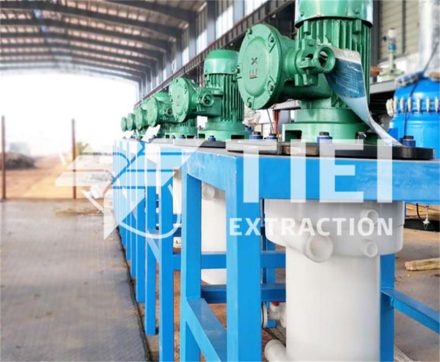
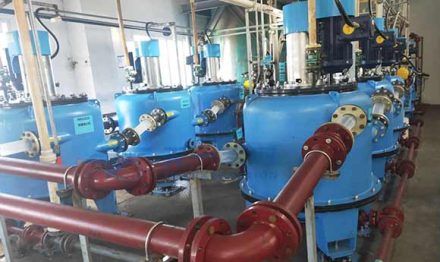
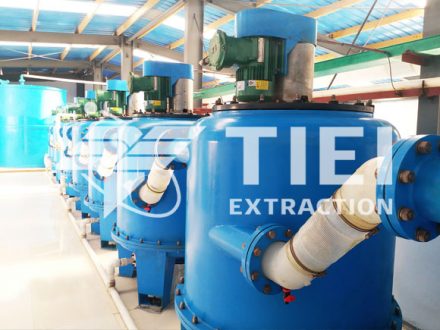
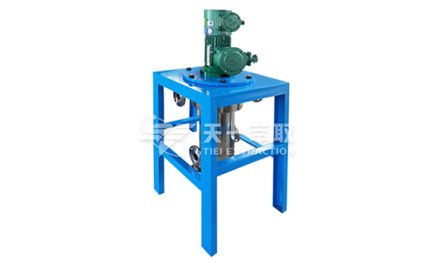
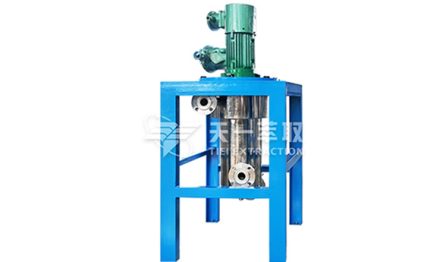
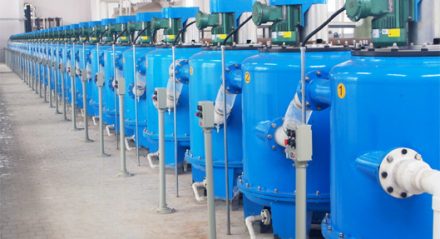
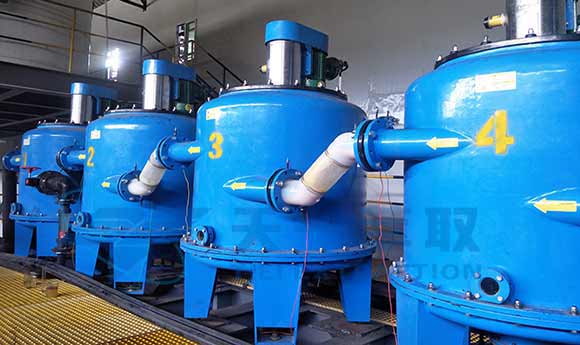
The CWL-M series centrifugal extractor independently developed by Zhengzhou Tiei Extraction Technology Co., Ltd. has become an ideal alternative to traditional equipment in multiple indium extraction production lines due to its unique design concept and outstanding engineering performance.
Its core advantages include the following:
1.Fully Fluorinated Polymer Materials for Long-Term Resistance to Strong Acid Corrosion
The wetted components of the equipment are made of advanced fully fluorinated polymer materials, enabling long-term stable operation in high-concentration acidic systems such as hydrochloric acid and sulfuric acid. The equipment eliminates the risk of metal ion dissolution, prevents secondary contamination of the process solution, and significantly extends service life.
2.Upper-Suspended Single Support Structure, Completely Solving Bottom Seal Leakage Problems
CWL-M centrifugal extractor adopts an upper-suspended support design, with the main shaft and motor located above the equipment body. There is no dynamic sealing point at the bottom. This structure fundamentally eliminates leakage and liquid cross-contamination problems caused by bottom seal wear in traditional centrifugal equipment, ensuring safer maintenance and a more environmentally friendly operation.
3.Extremely Short Residence Time, Rapid Phase Separation, Single-Stage Extraction Efficiency ≥90%
The high-speed rotation inside the CWL-M centrifugal extractor generates powerful centrifugal force, enabling rapid mass transfer after phase contact and completing separation within seconds.
Compared with gravity sedimentation equipment, the stage efficiency is significantly improved. The single-stage extraction efficiency can easily reach above 90%, effectively reducing the number of extraction stages and lowering investment costs.
4.Significant Reduction in Solvent Consumption and Operating Costs
Due to complete phase separation and extremely low entrainment, organic phase loss and subsequent washing water consumption are significantly reduced. The frequency of solvent regeneration is decreased, effectively controlling chemical costs and hazardous waste treatment costs throughout the extraction section.
5.Fully Enclosed Operation, Meeting High Safety and Environmental Protection Standards
The entire equipment operates under fully enclosed conditions without organic vapor emissions, improving the working environment while complying with increasingly strict occupational health and safety regulations. It is particularly suitable for projects with high environmental compliance requirements.
Practical Results in Indium Extraction Production Lines
In actual industrial applications, the CWL-M centrifugal extractor has successfully replaced traditional mixer settlers and has been applied in the extraction and stripping sections for indium recovery from zinc smelting leach solutions. Customer feedback shows that:
The number of extraction stages can be reduced by more than one-third compared with the original design, while plant floor space is reduced by nearly half.
Organic phase consumption is reduced by approximately 20%–30%, with washing water consumption reduced accordingly.
The purity of the produced indium consistently meets refining requirements, and the system demonstrates strong adaptability to fluctuations in feed flow rate and solution concentration, with flexible startup and shutdown operation.
These significant economic and technical benefits make the equipment suitable not only for newly constructed indium extraction projects but also for the technical upgrading and renovation of existing aging extraction lines.
Zhengzhou Tiei Extraction has been deeply engaged in the field of liquid-liquid extraction and separation for many years. Based on different mineral sources and varying leach solution compositions, we provide customized centrifugal extraction solutions for indium recovery projects and assist customers with pilot testing and process optimization.
If you are planning or upgrading an indium recovery project from zinc smelting leaching waste liquid, please feel free to contact us for detailed technical information or material testing.
Email: sales@tieiextraction.com
Whatsapp: +86 19069612820