In the production processes of the chemical, pharmaceutical, hydrometallurgical and other industries, extraction is an important unit operation in separation and purification. The selection of extraction equipment and processes directly affects separation performance, solvent consumption and operating costs. This article provides a systematic overview of the basic concepts of extraction, its applicable scenarios, mainstream equipment types and key equipment selection considerations.
Basic Concepts and Advantages of Extraction
Extraction, also known as solvent extraction or liquid-liquid extraction, is a separation operation that utilizes differences in the solubility or distribution coefficients of different components in two immiscible or slightly miscible solvents. Through this process, the target component is transferred from one phase to another, thereby achieving separation. The operation of separating the two phases after extraction is called phase separation.
Compared with separation methods such as distillation and precipitation, extraction offers several advantages, including operation at ambient temperatures, lower energy consumption, no involvement of solid or gas handling, and relatively convenient operation.
Typical Applications of Extraction
Extraction is not suitable for all separation systems, but it offers significant advantages in the following three scenarios:
1.Separation of systems with similar boiling points or azeotropic mixtures
Examples include the separation of alkanes and aromatics in petroleum fractions and phenol removal from coal tar. Distillation is often ineffective for these separations, making extraction a more suitable alternative.
2.Separation of low-concentration, high-boiling-point components
Examples include dehydration of dilute acetic acid and separation and purification of mineral leach solutions. Distillation of such systems generally involves high energy consumption, while precipitation methods may result in poor separation quality and significant filtration losses.
3.Separation of heat-sensitive or unstable substances
For example, in the production of penicillin from fermentation broth, extraction can be carried out under mild operating conditions, avoiding thermal decomposition of the material.
Currently, extraction can be used to recover and separate the vast majority of elements in the periodic table. The selection of extractants, determination of process conditions, and design of process flowsheets and equipment are the key aspects of developing an extraction operation.
Mainstream Extraction Equipment
Common extraction equipment mainly includes mixer-settler, centrifugal extractor and extraction column.
1.Mixer-Settler
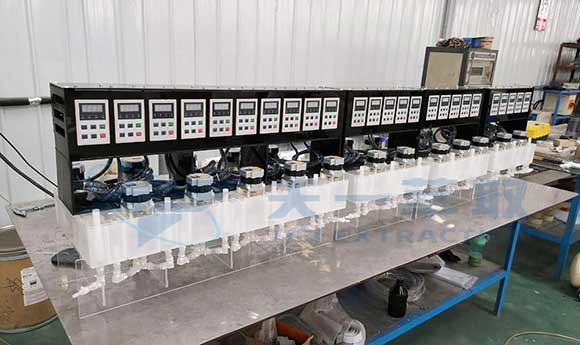
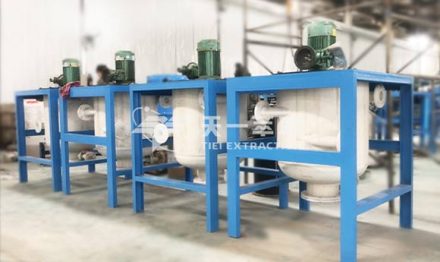
The mixer-settler consists of a mixing chamber and a settling chamber and is classified as a stagewise contact mass transfer equipment. The mixing chamber is equipped with an agitator to promote droplet breakup and uniform mixing. The settling chamber has a relatively large cross-sectional area to facilitate droplet coalescence and phase separation.
Mixer-settlers can be operated as single-stage units or connected in multiple stages for counter-current operation. They feature a simple structure, high stage efficiency and relatively small scale-up effects, making them suitable for various production scales. However, their investment and operating costs are relatively high, and they require a large installation area.
2.Centrifugal Extractor
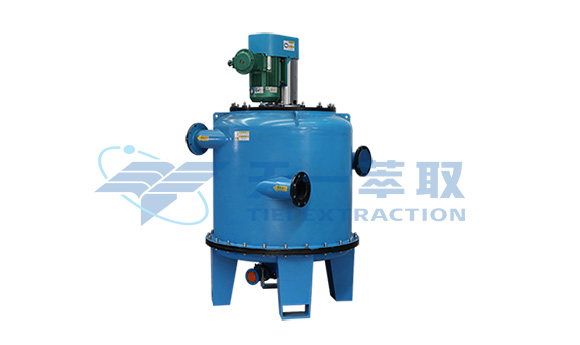
Centrifugal extractor utilizes centrifugal force to accelerate droplet settling and phase separation. They allow droplets to be broken into smaller sizes under relatively intensive mixing conditions, thereby enhancing the extraction process. Centrifugal extractors can be classified into two types: stagewise-contact and differential-contact centrifugal extractors. At present, stagewise-contact centrifugal extractors are the most commonly used type on the market.
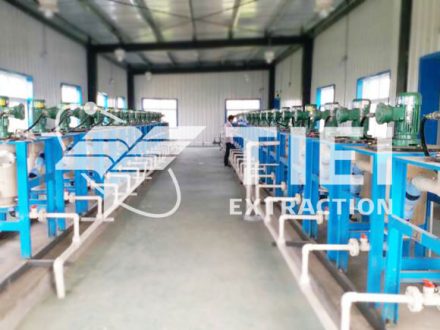
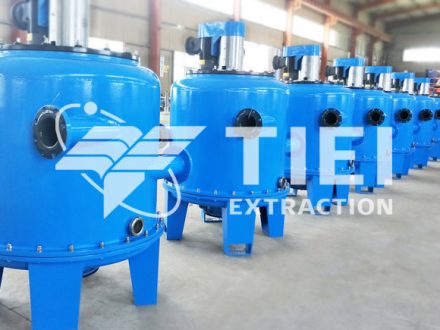
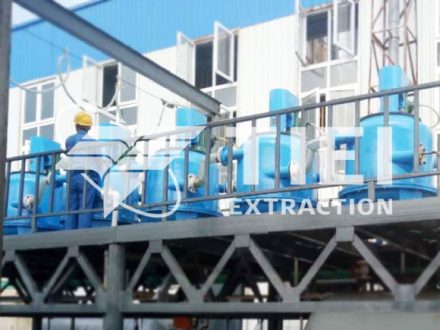
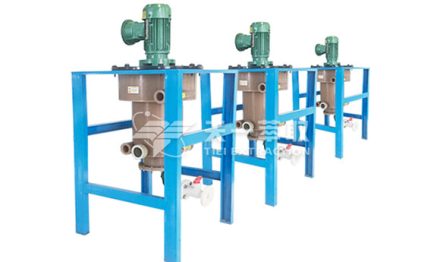
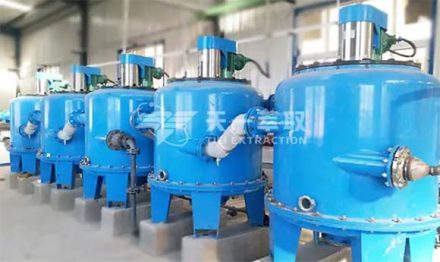
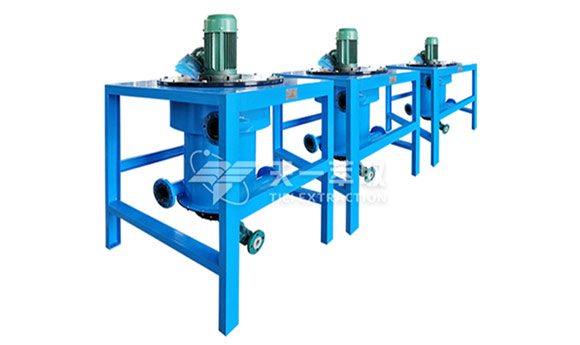
Taking the CWL-M series centrifugal extractor developed by Zhengzhou Tiei Extraction Technology Co., Ltd. as an example, this equipment was developed to address the limitations of traditional centrifugal extractors. Its power consumption is only 10%–30% of that of traditional annular-gap centrifugal extractors. CWL-M centrifugal extractor is particularly suitable for systems with small density differences between the two phases or a tendency to emulsify. They feature short phase retention time per stage, rapid phase separation, high extraction efficiency, and reduced investment costs as well as solvent recovery and regeneration costs. Due to the very short material residence time inside the equipment, CWL-M centrifugal extractor is also suitable for extracting substances with unstable chemical and physical properties.
As liquid-liquid extraction equipment, the CWL-M series can be connected in multiple stages to achieve continuous counter-current extraction. During process development, pilot-scale extraction tests can first be conducted using laboratory-scale centrifugal extractors. After obtaining key parameters such as the phase ratio and the required number of stages, the appropriate industrial extraction and separation equipment can then be selected.
3.Extraction Column
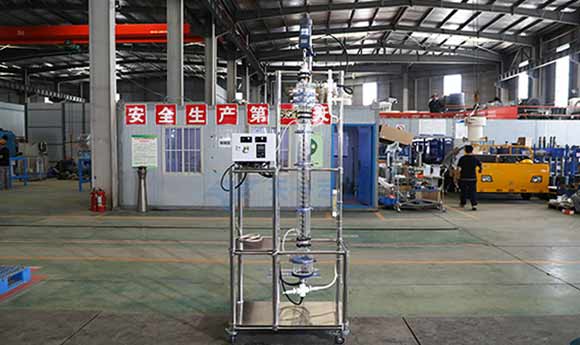
Extraction column include various types, such as packed columns, sieve-plate columns, rotating-disc columns, pulsed columns and vibrating-plate columns. An extraction column consists of a vertical cylindrical vessel. The light phase enters from the bottom and overflows from the top, while the heavy phase enters from the top and exits from the bottom. The two phases flow counter-currently through the column. Except for sieve-plate columns, most extraction columns are differential-contact mass transfer equipment. The middle section of the column serves as the operating zone, while the sections at both ends serve as separation zones. In packed columns and sieve-plate columns, liquid dispersion and mixing mainly rely on the energy of the flowing liquids themselves. Their equipment performance is relatively limited, so they are primarily used for systems that are relatively easy to extract or applications with less demanding separation requirements.
Key Considerations for Extraction Equipment Selection
The selection of extraction equipment should be based on a comprehensive evaluation of feed properties, processing capacity, separation difficulty, emulsification tendency, investment budget and operating costs. There is no single solution suitable for all applications.
Mixer-settler is suitable for applications requiring a large number of stages and high processing capacity, but they occupy a large installation area and involve relatively high solvent inventory.
Extraction column features a compact structure but are relatively sensitive to phase density differences and emulsification.
Centrifugal extractor offers rapid phase separation, high stage efficiency and a small footprint. They are particularly suitable for systems with small phase density differences, a tendency to emulsify, or heat-sensitive materials.
Zhengzhou Tiei Extraction Technology Co., Ltd. provides a complete product range, from laboratory-scale model to industrial CWL-M centrifugal extractors. For further information about extraction equipment selection or process validation, please contact the Zhengzhou Tiei Extraction Technology Co., Ltd.
Email: sales@tieiextraction.com
Whatsapp: +86 19069612820