Indium has excellent light transmission and electrical conductivity, making it widely used in electronic applications such as liquid crystal displays (LCDs) and flat-panel screens. Approximately 90% of the world's indium is derived from by-products of lead and zinc smelters. It is typically recovered and concentrated from dross, slag, and anode slime generated during copper, lead, and zinc smelting processes.
Currently, the mainstream equipment and process for indium extraction are based on the solvent extraction–electrowinning method. The general process flow is as follows:
Indium-containing raw materials → Enrichment → Chemical Dissolution → Purification → Extraction → Stripping → Zinc (Aluminum) Cementation → Indium Sponge → Electrolytic Refining → Refined Indium.6·1
Among these steps, solvent extraction is the key process determining the indium recovery rate and product purity.
Traditional indium extraction commonly uses mixer-settlers and spray extraction columns. Taking mixer-settlers as an example, they have several limitations, including a small contact area between the organic and aqueous phases, low mass transfer coefficients, limited processing capacity, and insufficient separation intensity. These limitations can easily lead to poor phase separation and high solvent entrainment. In addition, the long residence time of the feed solution in the tanks may result in solid precipitation and third-phase formation, affecting continuous operation.
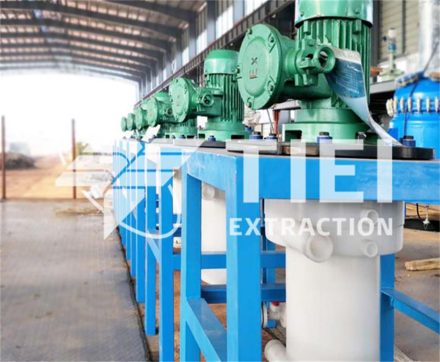
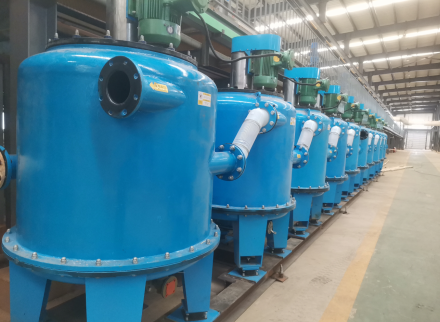
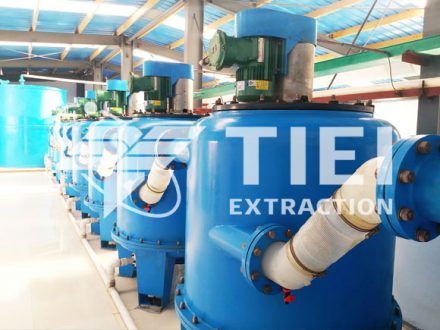
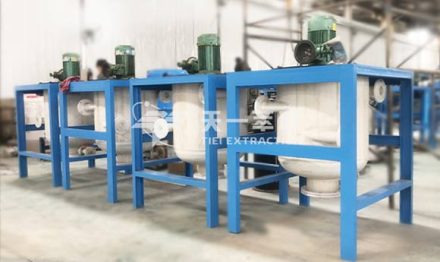
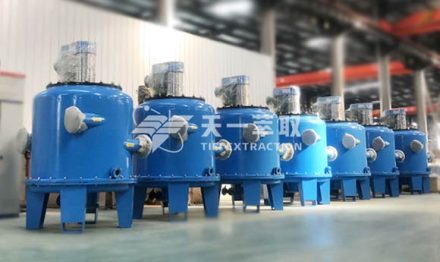
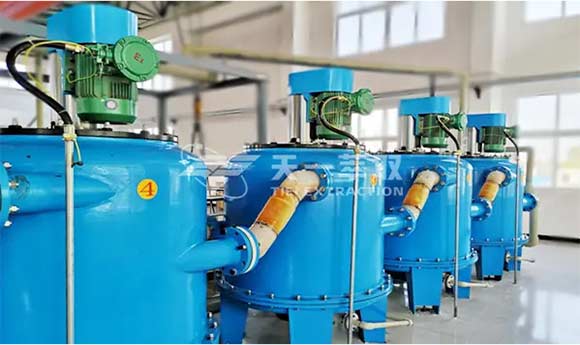
To address these limitations, Zhengzhou Tiei Extraction Technology Co., Ltd. has introduced a liquid-liquid extraction process based on the CWL-M Series Centrifugal Extractor, providing an efficient solution for recovering indium from indium-containing leach solutions.
Process Flow from Indium-Containing Leach Solution to Indium Ingots
1.Leaching
The indium-containing materials are mixed with sulfuric acid for leaching. The leaching time is controlled at 1.5–2 hours. After leaching, solid-liquid separation is carried out to obtain the indium-containing leach solution.
2.Reduction
Iron powder is added to the indium-containing leach solution to carry out the reduction reaction, producing a reduced solution.
3.Extraction
The extractant and reduced solution are fed into the CWL-M Series Centrifugal Extractor for solvent extraction. The extractant consists of P204 (di(2-ethylhexyl) phosphate) and kerosene. The volume ratio of extractant to reduced solution is (3–5):1, meaning that the organic-to-aqueous phase ratio is (3–5):1. The extraction process adopts 3–5 stages of counter-current extraction.
As the core liquid-liquid extraction equipment, the CWL-M Series Centrifugal Extractor uses a centrifugal force field to achieve rapid mixing and separation of the two phases. It features a short mixing time and rapid phase contact, effectively avoiding the solid precipitation and third-phase formation that may occur in traditional mixer-settlers due to prolonged mixing.
4.Stripping
Hydrochloric acid is introduced into the CWL-M Series Centrifugal Extractor to strip the loaded organic phase, producing an indium-rich stripping solution. The organic phase can be regenerated and recycled for reuse. The stripping process adopts 4–6 stages of counter-current extraction, with a hydrochloric acid concentration of 6–7 mol/L.
The equipment provides high separation intensity. By utilizing the density difference between the organic and aqueous phases, it achieves rapid phase separation under high-speed centrifugal force, ensuring effective separation and facilitating organic phase regeneration and reuse.
5.Indium Production
A reducing agent is added to the stripping solution to carry out the reaction, producing indium sponge through cementation. The indium sponge is then subjected to alkaline melting and ingot casting to obtain indium ingots with an indium content of 99.72%.
Application Advantages of the CWL-M Series Centrifugal Extractor
Compared with traditional tank-type extraction equipment, the CWL-M Series Centrifugal Extractor offers the following advantages:
1.Small Footprint: The equipment occupies only 1/5 of the floor space required by traditional tank-type extraction systems.
2.Low Liquid Hold-up: The equipment has a very small internal liquid hold-up, reducing the initial investment in organic solvent.
3.Excellent Sealing Performance: The fully enclosed structure minimizes organic solvent volatilization and provides a better operating environment.
4.No Leakage Risk: The top-suspended structure eliminates bottom bearings and mechanical seals, making maintenance simple and convenient.
5.Continuous Operation: The equipment features simple operation, a high level of automation, low energy consumption, and large processing capacity, making it suitable for continuous indium extraction processes.
For projects where process parameters are still being verified, laboratory-scale centrifugal extractors can be used for preliminary pilot testing to determine the extractant ratio, phase ratio, and number of extraction stages. After obtaining data on indium extraction efficiency and phase separation performance, the appropriate industrial-scale extraction and separation equipment can then be selected. Zhengzhou Tiei Extraction Technology Co., Ltd. provides a complete product range, from laboratory-scale to industrial CWL-M Series Centrifugal Extractors.
For more detailed about centrifugal extractor, please contact the Zhengzhou Tiei Extraction for further consultation.
Email: sales@tieiextraction.com
Whatsapp: +86 19069612820