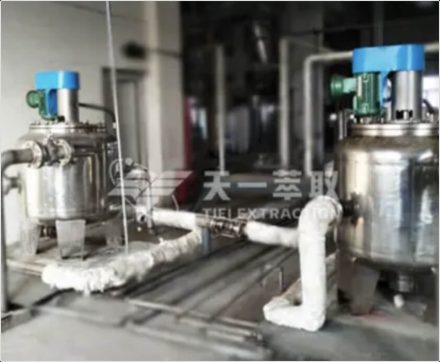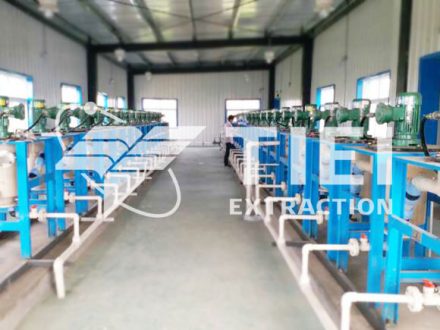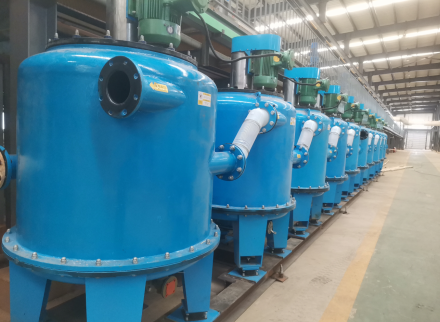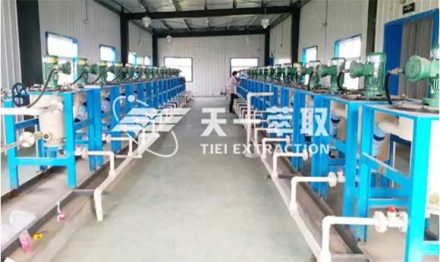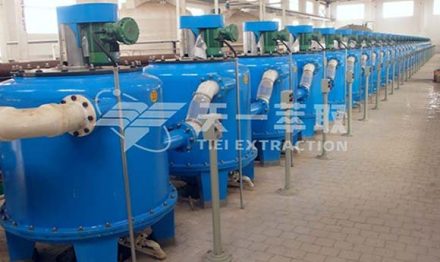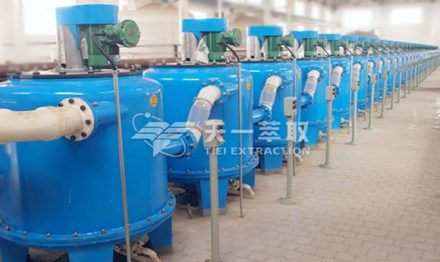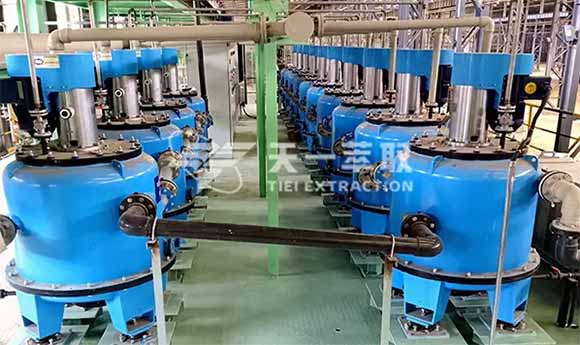
Copper, nickel, and cobalt are core metals for strategic industries such as new energy batteries, high-temperature alloys, and magnetic materials. With the explosive growth of the new energy vehicle and energy storage markets, demand for high-purity nickel, cobalt, and copper continues to rise. However, copper, nickel, and cobalt are often co-associated in sulfide ores or laterite nickel ores, and solvent extraction and separation is the key process for obtaining high-purity single-metal products.
In copper–nickel–cobalt solvent extraction separation, traditional mixer-settlers and extraction columns have long faced challenges such as high stage numbers, large footprint, slow phase separation, severe emulsification, and high organic entrainment. The CWL-M centrifugal extractor is becoming the preferred upgrade solution for an increasing number of hydrometallurgical projects.
Core Advantages of the CWL-M Centrifugal Extractor
1.Drastically reduced stages and over 70% footprint savings
The extraction efficiency of a single CWL-M centrifugal extractor is equivalent to 3–5 stages of a mixer-settler. In nickel–cobalt separation circuits, where 20–30 stages were traditionally required, only 8–10 units in series are now needed to achieve the same separation performance. Equipment footprint can be reduced by over 80%, significantly lowering civil engineering and piping investment.
2.Forced demulsification and up to 90% reduction in organic losses
The centrifugal force field reduces two-phase contact time to just tens of seconds, enabling much faster phase disengagement than gravity settling. For feed solutions prone to emulsification, such as those with high silicon, aluminum, and iron content, emulsions are forcibly broken under centrifugal force. Organic phase entrainment is reduced from the conventional 150–300 ppm to less than 50 ppm, and annual organic consumption can be reduced by 80–90%.
3.Highly corrosion-resistant design with short payback period
The drum can be made of 2205/2507 duplex stainless steel or titanium (TA2), while the housing can be 316L stainless steel or FRP lining, allowing resistance to highly concentrated sulfate solutions and chloride corrosion (≤20,000 ppm). Considering equipment, civil engineering, and operating costs, although the CWL-M centrifugal extractor solution has a slightly higher initial investment, it significantly reduces annual operating costs, with a typical payback period of 10–14 months.
Three Key Questions Customers Care About
Copper–nickel–cobalt solvent extraction separation: why are more and more companies choosing the CWL-M centrifugal extractor?
In every discussion with hydrometallurgical clients, the most frequently asked questions are:
Question 1: The solvent extraction and separation of copper–nickel–cobalt involve a large number of stages and require a significant footprint; how many stages can be eliminated by using centrifugal extractors?
Yes—and typically by more than 40%.
Copper–nickel–cobalt extraction systems (such as P204 for impurity removal, P507 for nickel–cobalt separation, and Cyanex 272 for deep purification) require multi-stage counter-current operation. Traditional mixer-settlers have low single-stage efficiency, which leads to 20–30 stages for nickel–cobalt separation, and a single production line occupies hundreds of square meters. Extraction columns have a slightly smaller footprint, but mass transfer efficiency is limited by column height and axial back-mixing issues.
Solution of the CWL-M centrifugal extractor:
1.By utilizing an 800–1200G centrifugal force field, two-phase droplets are broken down to micron scale, increasing interfacial area by 5–8 times, and achieving single-stage extraction efficiency of 90%–95%.
2.Under the same separation requirements, the number of required stages is reduced to 50%–60% of that of mixer-settlers. For example, nickel–cobalt separation traditionally requires 24 stages, while only 10–12 CWL-M centrifugal extractors are needed.
3.With an integrated design, each unit completes both mixing and separation, and stages are connected directly via piping. A 12-stage centrifugal extraction system occupies about 15–20 m², only 1/5 to 1/3 of a mixer-settler system.
Question 2: During the solvent extraction of copper–nickel–cobalt, issues such as emulsification, third-phase formation, and solvent entrainment frequently occur; how can these be controlled?
CWL-M centrifugal extractor: rapid separation + built-in demulsification capability.
Copper–nickel–cobalt leach solutions often contain iron, aluminum, and silica colloids, which easily form stable emulsions or a third phase during extraction. Mixer-settlers rely on gravity separation, typically requiring 30–60 minutes; emulsions are difficult to eliminate, and organic phase entrainment can reach 3%–5%, resulting in tens of thousands of yuan in annual extractant losses.
Solution of the CWL-M centrifugal extractor:
1.Under strong centrifugal force (>800G), two phases with different densities are separated within 1–2 seconds, and emulsified droplets are forcibly disengaged, resulting in a clear interface between light and heavy phases.
2.The drum is designed with special flow channels that provide a “shear demulsification” effect, enabling even mild emulsions to be broken down.
3.Measured organic entrainment is reduced to below 0.1%, solvent losses are reduced by 30%–50%, and annual solvent cost savings reach 200,000–500,000 RMB (for a medium-scale plant).
Question 3: What about corrosion resistance and investment payback?
Material selection is customizable; typical payback period is 12–18 months.
Copper–nickel–cobalt hydrometallurgical systems are typically high-concentration sulfate systems, and when chloride ions are present, corrosion becomes extremely severe. Standard 304 stainless steel may suffer pitting corrosion within weeks.
The CWL-M centrifugal extractor provides multiple corrosion-resistant configurations:
| Component | Optional Materials | Application Conditions |
| Drum | 316L, 2205 duplex stainless steel, titanium, fluoroplastics | Conventional sulfate systems / chloride-containing systems / high acid & high temperature |
| Housing | 316L, PP, fluoropolymer lining | Corrosion protection / lightweight design |
| Frame | Carbon steel with coating, stainless steel | General environments / cleanrooms |
Application Cases
1.HPAL project (nickel–cobalt separation):
Processing capacity 45 m³/h, 9 sets CWL-M450 units replacing a 28-stage mixer-settler system. Cobalt extraction rate >99.2%, raffinate Co <8 ppm, footprint reduced by 81%, organic consumption reduced by 76%.
2.Copper–cobalt ore (copper extraction retrofit):
120 m³/h capacity, 8sets CWL-M550 units replacing mixer-settlers. Copper extraction increased from 92.5% to 97.8%, entrainment reduced from 220 ppm to 35 ppm, payback period 14 months.
3.Battery recycling (black mass leach solution):
6 sets CWL-M350 units achieved nickel–cobalt separation factor β(Co/Ni) >850, meeting battery-grade precursor requirements, with 14 months of continuous operation without major overhaul.
Zhengzhou Tiei Extraction provides full-chain services from laboratory feasibility testing, pilot-scale validation, process package design, equipment manufacturing, to on-site installation and commissioning. The CWL-M centrifugal extractor series has been operating stably in multiple copper–nickel–cobalt and battery recycling projects.
If you need stage calculation, material selection, or investment return analysis for your specific process system, feel free to contact us for a detailed technical solution.
Email: sales@tieiextraction.com
Whatsapp: +86 19069612820