Battery black mass, obtained after crushing and sorting spent lithium-ion battery cathode materials such as lithium nickel cobalt manganese oxide (NCM) and lithium cobalt oxide (LCO), contains valuable metals including nickel, cobalt, lithium, and manganese. However, these metals are closely associated and possess similar chemical properties, making their separation and recovery highly challenging. Traditional extraction processes often suffer from low recovery rates, poor product purity, and high operating costs.
Three Major Challenges in Battery Black Mass Metal Recovery
1.Incomplete Leaching Leads to Valuable Metal Losses
Conventional acid leaching processes typically achieve metal leaching efficiencies of only 85–90%. Manganese and part of the cobalt often remain in the residue, resulting in significant losses of valuable metals and reducing overall profitability.
2.Costly and Complex Separation & Purification
Nickel, cobalt, manganese, and lithium ions exhibit similar chemical behaviors. Traditional precipitation methods require repeated pH adjustments and multiple impurity-removal stages, leading to lengthy process flows, high reagent consumption, and elevated processing costs.
3.Increasing Environmental Compliance Pressure
The extensive use of extractants, acids, and alkalis generates large volumes of high-salinity wastewater and spent organic phases. End-of-pipe treatment becomes costly and complex, while stricter environmental regulations continue to raise compliance requirements.
These challenges are not merely technical issues—they directly impact a recycling company's competitiveness in the rapidly growing battery recycling industry. Today, we introduce an innovative solution that transforms battery black mass from a processing challenge into a valuable source of high-purity battery metals: Centrifugal Extraction Technology.
Counter-Current Centrifugal Extraction Technology
Traditional solvent extraction can be compared to allowing oil and water to separate naturally in large settling tanks—slow, space-consuming, and requiring many stages. By contrast, the centrifugal extraction technology functions like a highly efficient "metal separation accelerator," delivering rapid mass transfer and precise metal recovery.
1.Rapid Metal Leaching
Battery black mass undergoes reductive acid leaching, transferring nickel, cobalt, lithium, and manganese into solution. Through optimized leaching conditions, metal recovery from black mass can exceed 99%, maximizing resource utilization.
2.Selective Metal Extraction
The leachate flows sequentially into a multi-stage centrifugal extraction unit. Each stage employs an extractant highly selective for a specific metal (such as P507, Cyanex 272, etc.). The first stage extracts manganese, the second extracts cobalt, and the third extracts nickel, while the lithium remains in the aqueous phase.
3.Ultra-Fast Phase Separation
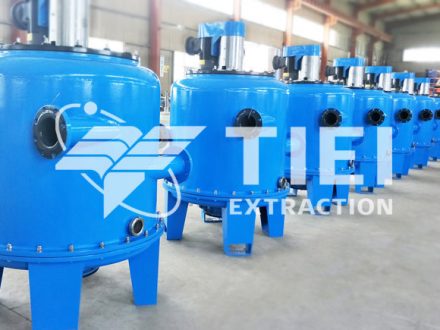
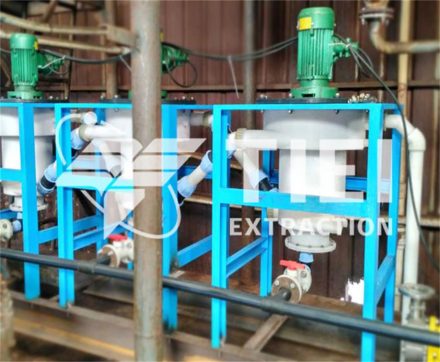
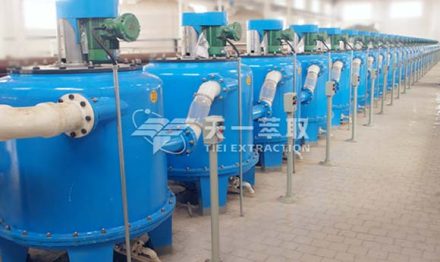
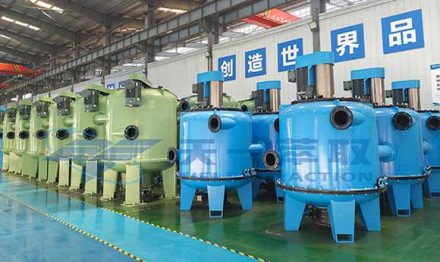
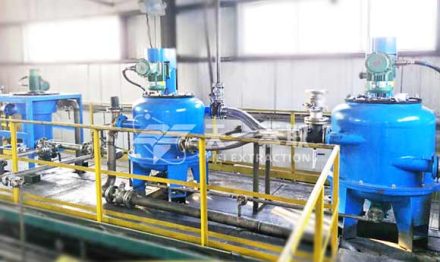
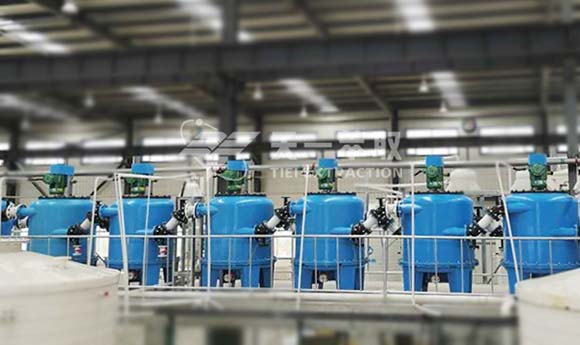
Inside the CWL-M Centrifugal Extractor, centrifugal forces hundreds of times greater than gravity enable mixing, mass transfer, and phase separation within seconds. Each extraction stage acts as a precise "sorting station," achieving separation efficiencies 5–10 times higher than conventional mixer-settlers or extraction columns.
4.Efficient Stripping
The metal-loaded extractant comes into contact with a small amount of high-concentration stripping agent, instantly releasing a high-purity metal salt solution (such as nickel sulfate or cobalt sulfate). The extractant is then recycled, with near-zero consumption.
5.Crystallization into Battery-Grade Products
The purified metal solutions are subsequently concentrated and crystallized to produce battery-grade nickel sulfate, battery-grade cobalt sulfate, battery-grade manganese sulfate, lithium carbonate (Li₂CO₃), lithium hydroxide (LiOH). Product purities typically exceed 99.5%, meeting the stringent requirements of cathode precursor and battery material manufacturers.
Why More Battery Recycling Companies Are Choosing Centrifugal Extraction Technology
1.Eliminating Cross-Contamination and Achieving High-Purity Metal Separation
Traditional chemical precipitation methods: Nickel and cobalt tend to co-precipitate, while manganese and lithium are often lost together. Repeated re-dissolution and purification are required, yet product purity is difficult to increase beyond 98%.
Centrifugal extraction technology: By combining physical and chemical separation mechanisms, each extraction stage offers extremely high selectivity. The separation rates of nickel, cobalt, and manganese can all exceed 99%, while product purity remains stable at 99.8%, meeting the standards required for battery cathode materials.
2.Significantly Reduce Costs and Reagent Consumption
The processing cost of traditional black mass recycling is typically around RMB 12,000–15,000 per ton, including reagents, energy consumption, and wastewater treatment.
The CWL-M centrifugal extraction process reduces overall costs by 40%–50% because the extractant is recycled, reaction times are short, and repeated heating is unnecessary. In addition, each ton of black mass can yield an extra RMB 2,000–3,000 worth of recovered metals.
3.Compact and Modular Design for Flexible Capacity Expansion
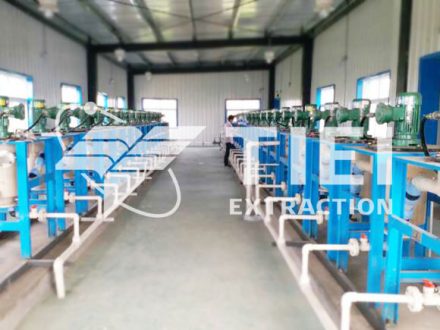
The CWL-M centrifugal extraction system can complete multiple separation stages while occupying only one-third of the space required by traditional extraction columns and mixer settlers.
Its modular design allows flexible configurations for processing capacities ranging from 1 ton to 50 tons of black mass per day. Capacity expansion can be achieved simply by adding more modules.
4.Fully Enclosed Operation for Easier Environmental Compliance
The system operates in a closed configuration, preventing leakage of organic vapors and ensuring safe and environmentally friendly operation.
After impurity removal, the raffinate solution (mainly the lithium-containing aqueous phase) can be used for lithium salt precipitation. Wastewater discharge is reduced to nearly zero, making environmental compliance much easier.
Real Production Data: Feedback from Industrial Operations
We do not simply provide equipment—we work together with our customers to overcome the challenges of battery black mass metal recovery.
- Case Study: A Battery Recycling Company (Processing 20 tons of black mass per day, NCM523 system)
- Challenges: The company previously used a combined chemical precipitation and extraction process. Nickel and cobalt contamination levels were high, extractant consumption was excessive, and the lithium recovery rate was only 78%.
- Solution: A four-stage counter-current CWL-M centrifugal extraction system was adopted for the sequential separation of: Manganese → Cobalt → Nickel → Lithium Concentration
- Results: Nickel recovery rate 99.2%, Cobalt recovery rate 98.7%, Manganese recovery rate 97.8%, Lithium recovery rate 93.5%
- Product Purity: Nickel sulfate solution purity 99.9%, Cobalt sulfate purity 99.8%
From a wastewater burden to a valuable metal resource, and from mixed impurities to high-purity separation, centrifugal extraction technology is opening a new door for the high-value recovery of battery black mass.
If you are also troubled by low recovery rates, insufficient purity, or high processing costs in black mass extraction, consider this "fast, precise, and economical" separation revolution—the CWL-M centrifugal extraction process. It may be the key to improving both profitability and sustainability in your battery recycling operation.
Email: sales@tieiextraction.com
Whatsapp: +86 19069612820