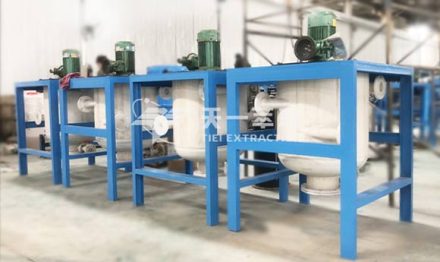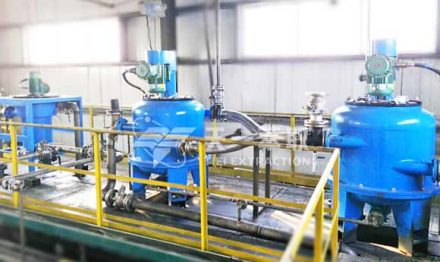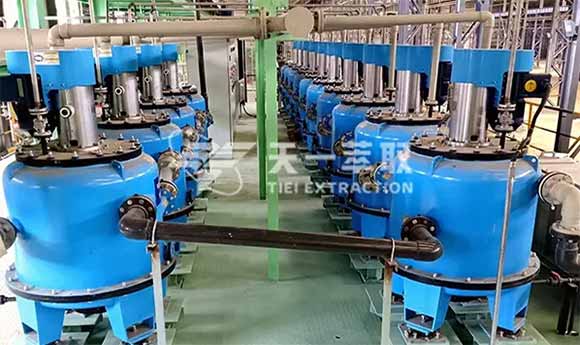
Copper, nickel, and cobalt are important metals for strategic industries such as new energy batteries and superalloys. They are often associated with sulfide ores or laterite nickel ores. To obtain high-purity copper, nickel, and cobalt products, solvent extraction and separation is one of the key process steps. However, in copper-nickel-cobalt extraction and separation, as well as nickel-cobalt separation, traditional mixer-settlers or extraction columns often face challenges such as a large number of stages, large footprint, slow phase separation, high solvent entrainment, and difficult emulsion breaking.
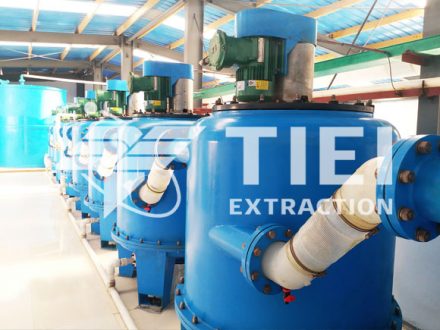
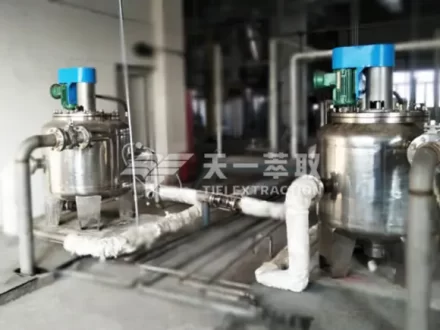
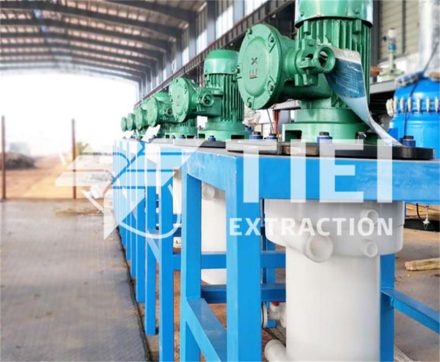
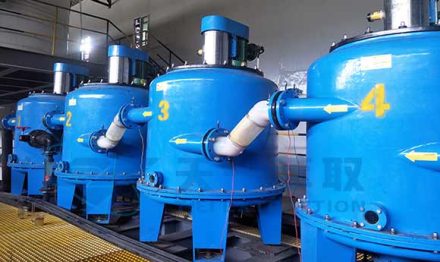
To address these challenges, the CWL-M centrifugal extractor provides a more targeted solution. By enhancing the centrifugal force field and mass transfer efficiency, it helps hydrometallurgical projects achieve more compact, stable, and efficient copper-nickel-cobalt extraction and separation.
Why Is Copper-Nickel-Cobalt Extraction and Separation Challenging?
Copper, nickel, and cobalt have similar chemical properties. In particular, during nickel-cobalt separation, the separation factor is relatively small, and multiple stages of counter-current extraction are often required to achieve the target purity. Traditional processes typically face the following challenges:
- A large number of extraction stages, resulting in a long process flow, high equipment investment, and high operating costs.
- Mixer-settlers occupy a large area and have slow phase separation.
- The feed solution is prone to emulsification, resulting in high organic-phase entrainment and increased solvent losses.
- Extraction columns may experience back-mixing and channeling, affecting separation performance.
- High requirements for corrosion-resistant materials can limit equipment service life and increase maintenance costs.
These issues directly affect the recovery rate, product purity, and overall project economics of copper-nickel-cobalt extraction and separation.
Key Advantages of the CWL-M Centrifugal Extractor
1.Significantly Reduces the Number of Extraction Stages
The CWL-M centrifugal extractor utilizes an 800–1200 G centrifugal force field to micronize liquid droplets, increasing the mass transfer area by 5–8 times. The single-stage efficiency can reach 90%–95%. Compared with traditional equipment, the total number of extraction stages can be reduced by more than 40%.
Taking nickel-cobalt separation as an example, a traditional process may require 24 stages, while only 10–12 stages may be required when centrifugal extraction is adopted. A 12-stage system occupies only 15–20 square meters, approximately 1/5–1/3 of the footprint of a mixer-settler system. This is particularly important for projects with limited space or those seeking to shorten the process flow.
2.Rapid Emulsion Breaking and Entrainment Control
Under the action of centrifugal force, the CWL-M centrifugal extractor can complete two-phase separation within 1–2 seconds. The special flow channels inside the rotating drum provide a shear-induced emulsion-breaking effect, effectively reducing the impact of emulsification. The organic-phase entrainment rate is below 0.1%, while solvent losses can be reduced by 30%–50%.
For copper-nickel-cobalt extraction and separation, controlling entrainment not only affects operating costs but also contributes to the stability of subsequent stripping, electrowinning, or crystallization processes.
3.Flexible Material Selection and Corrosion Resistance
The CWL-M centrifugal extractor can be manufactured using materials such as 316L stainless steel, 2205 duplex stainless steel, titanium, or fluoroplastics, depending on the feed solution system. The equipment has a designed service life of up to 10 years and is suitable for long-term continuous operation. Under suitable operating conditions, the typical payback period for a project is 12–18 months.
4.Improved Recovery and Economic Benefits
By enhancing mass transfer and improving phase separation, the CWL-M centrifugal extractor helps increase the recovery rates of copper, nickel, and cobalt. In practical applications, recovery rates can be improved by 4%–6%, providing more stable economic benefits for hydrometallurgical projects.
Applications of the CWL-M Centrifugal Extractor
The CWL-M centrifugal extractor can be used in a variety of copper-nickel-cobalt extraction and separation applications, including:
Copper extraction and copper-cobalt separation
Nickel-cobalt separation and nickel-cobalt purification
Hydrometallurgy of laterite nickel ores
Treatment of leach solutions from nickel sulfide ores
Nickel-cobalt-manganese separation in spent battery recycling
Preparation of high-purity metal salts and solution purification
Depending on the feed solution composition, extraction system, and target product purity, the CWL-M centrifugal extractor can be integrated with extraction, scrubbing, stripping, and other process steps to form a continuous and automated extraction and separation system.
Conclusion
Copper-nickel-cobalt extraction and separation is developing toward greater efficiency, compactness, and lower losses. By enhancing mass transfer, enabling rapid phase separation, reducing entrainment, and offering flexible material selection, the CWL-M centrifugal extractor provides a competitive solution for nickel-cobalt separation, copper-cobalt separation, and hydrometallurgical projects.
If you are planning a copper-nickel-cobalt extraction and separation project, please contact Zhengzhou Tiei Extraction. By providing your feed solution parameters and process objectives, you can obtain equipment selection recommendations and an experimental testing plan for the CWL-M centrifugal extractor.
Email: sales@tieiextraction.com
Whatsapp: +86 19069612820