With the continuous growth in the global vehicle population and increasingly stringent exhaust emission standards, three-way catalytic converters, as core emission purification devices in automotive exhaust systems, have seen a significant increase in the use of platinum group metal (PGM) active components, namely platinum (Pt), palladium (Pd), and rhodium (Rh). Platinum group metals are scarce and expensive resources, while their concentrations in spent catalysts are significantly higher than those in primary ores. As a result, spent catalysts are regarded as “urban mines” or “recyclable platinum mines.” In recent years, a large number of vehicles equipped with catalytic converters have gradually reached the end of their service life, making spent catalyst recycling an indispensable part of the precious metal supply chain and creating higher requirements for recovery efficiency and economic viability.
Automotive exhaust catalysts mainly consist of three components: a honeycomb-shaped substrate, typically cordierite ceramic and, in a small number of cases, Fe-Cr-Al alloy; a high-specific-surface-area coating; and platinum group metal active components dispersed throughout the coating. Compared with primary platinum group metal ores, spent catalysts offer significant advantages, including high metal content, fewer types of impurities, and concentrated sources. The recovery process generally includes several stages: pretreatment (collection, decasing, crushing, and grinding), platinum group metal enrichment, advanced separation and purification, and final metal reduction.
At present, platinum group metal enrichment technologies are mainly divided into two major routes: pyrometallurgical and hydrometallurgical processes. Pyrometallurgical enrichment, such as metal collection and gas-phase chlorination volatilization, uses additives and high-temperature smelting to separate platinum group metals from the substrate and obtain a high-grade concentrate. However, these processes require substantial investment and have relatively high energy consumption, making them generally more suitable for large-scale centralized treatment. Hydrometallurgical enrichment, on the other hand, employs acid leaching or alkaline leaching processes to selectively dissolve platinum group metals or base metals, thereby separating them from the inert substrate. Although hydrometallurgical processes may have slightly lower recovery rates in a single operation compared with pyrometallurgical methods, their mature technology, moderate equipment investment, and operational flexibility have made them one of the mainstream methods for recovering platinum group metals from secondary resources worldwide.
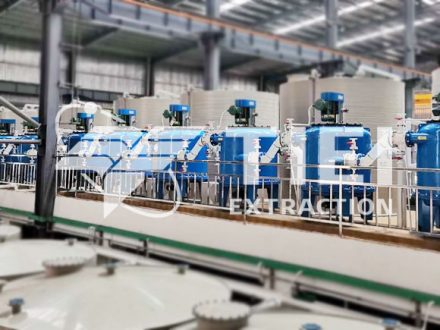
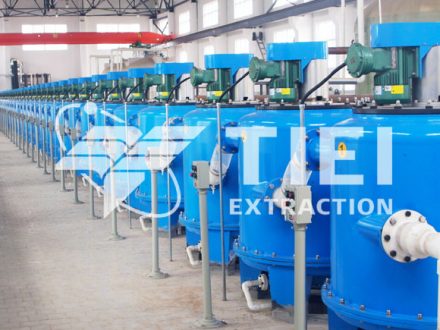
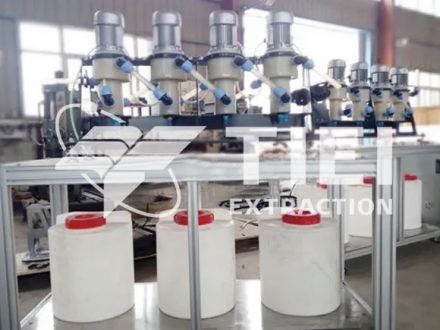
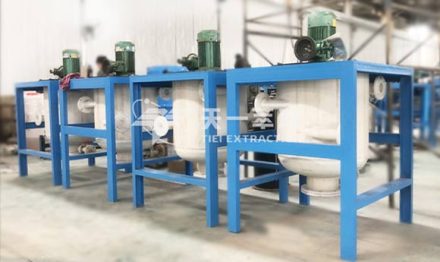
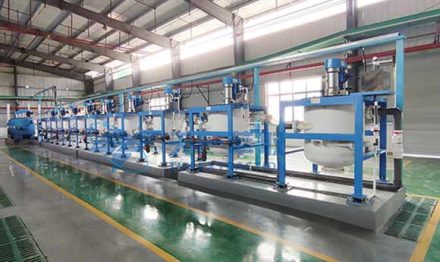
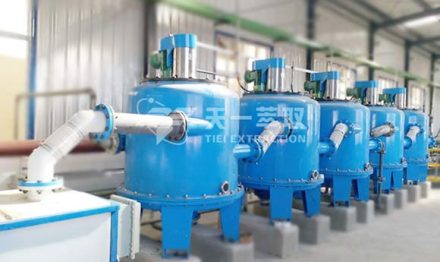
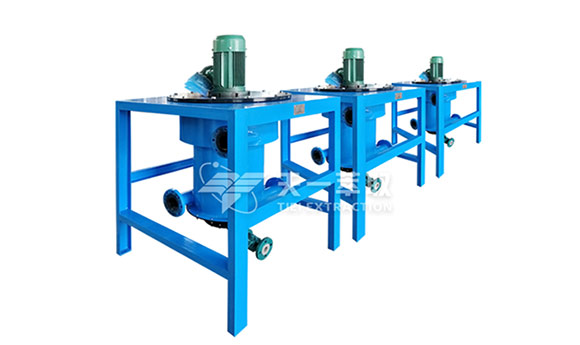
After hydrometallurgical leaching, platinum group metals are typically present in complex leach solutions in the form of low-concentration ions. How to efficiently and selectively separate and concentrate these metals is a critical factor determining the overall economic viability of the recovery process. The CWL-M Series Centrifugal Extractor developed by Zhengzhou Tiei Extraction Technology Co., Ltd. is a core liquid-liquid extraction equipment specifically designed for this stage. By utilizing the centrifugal force generated by high-speed rotation, the equipment enables rapid mixing, mass transfer, and phase separation of the two liquid phases. It offers outstanding advantages such as high extraction efficiency, rapid phase separation, and short residence time per stage. In addition, its fully enclosed operation can effectively reduce the volatilization of the organic phase, improve the operating environment, and minimize solvent losses.
Compared with conventional gravity-settling extraction equipment, such as mixer-settlers and extraction columns, the CWL-M Centrifugal Extractor provides more stable extraction performance and lower entrainment losses when processing low-concentration, high-value materials such as platinum, palladium, and rhodium leach solutions. It is particularly suitable for multi-stage counter-current extraction processes, helping to significantly increase the overall recovery of platinum group metals while reducing reagent consumption.
Zhengzhou Tiei Extraction provides high-performance centrifugal extraction equipment covering the entire process from leach solution pretreatment, multi-stage extraction, washing, and stripping to the production of platinum group metal-rich solutions. We support laboratory-scale testing, pilot-scale testing, and industrial-scale process and equipment design based on customers’ specific material characteristics. We are committed to helping customers worldwide achieve efficient and cleaner recovery of platinum group metal resources.
For further information on hydrometallurgical solvent extraction and separation processes, equipment selection, or project cases, please feel free to contact us for further discussion.
Email: sales@tieiextraction.com
Whatsapp: +86 19069612820