N-Methyl-2-pyrrolidone (NMP) is a high-performance organic solvent widely used in industries such as lithium batteries, polymer manufacturing, electronic materials, and lubricating oil refining. However, NMP is completely miscible with water in any proportion and features a high boiling point and flash point, making it difficult to separate and recover directly from aqueous solutions. As a result, the treatment of high-concentration NMP wastewater has become a major environmental challenge restricting sustainable industrial development.
Current Challenges in NMP Wastewater Treatment
- High Solvent Cost: A large amount of valuable NMP remains in wastewater. Distilling one ton of NMP wastewater typically consumes electricity and steam equivalent to more than 500 kWh, yet the recovered NMP purity is often below 90%, which fails to meet production requirements. Purchasing fresh NMP directly results in significant operating costs.
- Expensive Wastewater Disposal: Due to its high COD concentration, outsourcing NMP wastewater treatment to third-party providers is extremely costly. In-house treatment often faces considerable technical barriers.
- Increasing Environmental Pressure: With increasingly stringent discharge regulations, traditional treatment methods such as distillation often struggle because NMP and water are difficult to separate effectively. This leads to low recovery efficiency, poor product purity, and unstable compliance with environmental standards.
This is no longer just a cost issue—it directly impacts a company’s sustainable competitiveness. Today, we introduce an innovative solution that transforms “wastewater burden” into a valuable resource: Centrifugal Extraction Technology.
Centrifugal Extraction Technology
Traditional extraction is like waiting for oil and water to slowly separate in a stationary cup—inefficient and space-consuming. Our CWL-M Centrifugal Extractor, by contrast, functions as a high-speed separation accelerator.
- 1.Precise “Capture”: Pretreated NMP wastewater is mixed with a specially formulated extractant designed to selectively “capture” NMP molecules, and both are fed into the centrifugal extractor.
- 2.Rapid “Separation”: Inside the machine, under a centrifugal force field, the two liquid phases are intensely yet precisely mixed and contacted. NMP molecules are rapidly transferred into the extractant phase. The entire process is completed within seconds, delivering efficiency far beyond conventional methods.
- 3.Efficient “Purification”: The NMP-loaded extractant then enters the next process stage, where a simple stripping step releases high-purity NMP. The extractant acts like a reusable “carrier” and can be recycled repeatedly, significantly reducing operating costs.
- 4.Final “Refining”: The recovered NMP solution is then refined through distillation, easily achieving purity levels above 99%, making it ready for direct reuse in upstream production processes.
- 5.Wastewater “Purification”: After NMP removal, the wastewater COD level is dramatically reduced. Only simple biological treatment is required afterward to ensure stable compliance with discharge standards.
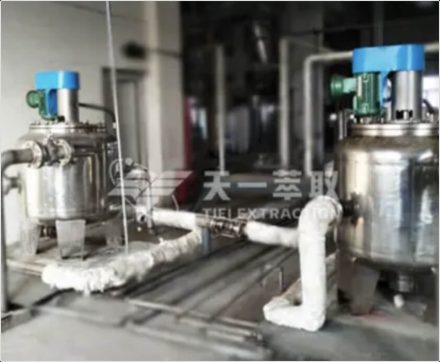
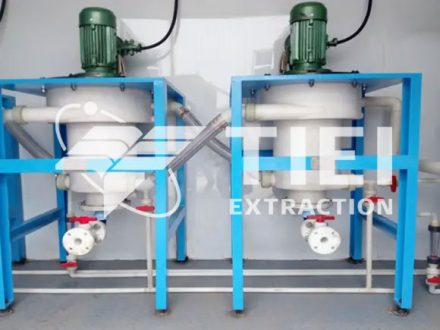
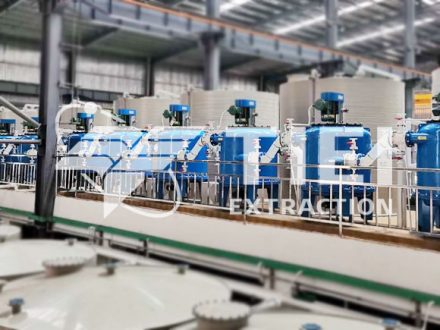
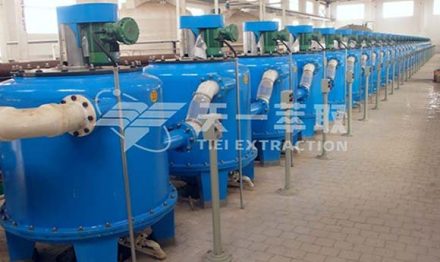
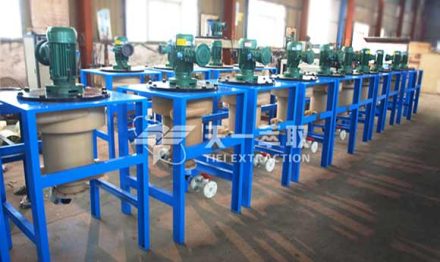
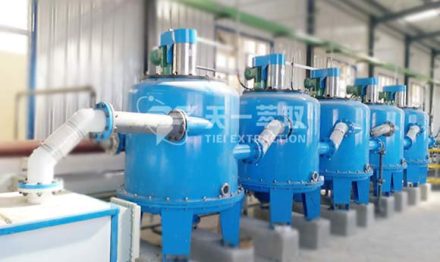
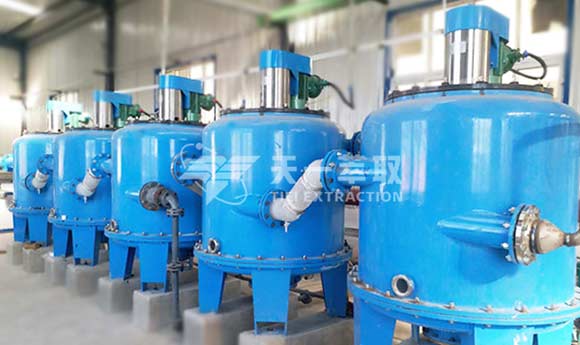
Tiei Extraction CWL-M Centrifugal Extractor for NMP Wastewater Treatment
1.Break Free from the “Azeotrope Limitation” — Significant Improvements in Both Recovery Rate and Purity
Traditional Distillation: Limited by the azeotropic behavior of NMP and water, recovery rates are often restricted to 75%–80%, with recovered NMP purity around 90%, making it unsuitable for direct reuse in high-standard production processes.
Centrifugal Extraction: As a physical separation process, centrifugal extraction is not affected by azeotropic limitations. It easily achieves recovery rates above 95%, with product purity consistently exceeding 99%, ensuring every drop of NMP is fully utilized.
2.Reduce Energy Consumption and Operating Costs
Unlike distillation, which requires continuous heating and large amounts of steam, the Tiei Extraction CWL-M Centrifugal Extractor operates through high-speed rotational centrifugal force generated. Its unit energy consumption is only one-third to one-quarter that of conventional distillation. In addition, the extractant is fully recyclable with nearly zero consumption. For manufacturers, this means substantial cost savings for every ton of wastewater treated.
3.Compact, Flexible, and Ideal for Modern Production Facilities
The CWL-M Centrifugal Extractor integrates both mixing and separation into a single unit. Its footprint is often only a fraction of that required by traditional extraction columns. With a modular design, multiple units can be flexibly combined according to processing capacity requirements, making future production expansion simple and efficient.
4.Stable Operation for Worry-Free Performance
The system operates in a fully enclosed design, eliminating exhaust leakage and providing a safer, more environmentally friendly solution. High automation and strong adaptability to wastewater quality fluctuations significantly reduce operational complexity and manual intervention.
Application Cases: Proven Results from Customer Sites
We do more than provide equipment—we work together with customers to solve complex NMP wastewater challenges.
Case 1: An Aramid Fiber Enterprise(High-Salinity NMP Wastewater with 5%–10% Salt Content)
Current Pain Points: The customer originally used distillation, which caused columns blockage twice a week, and the recovered NMP purity was only 88%.
Technical Solution: CWL-250M centrifugal extractor with three-stage counter-current extraction.
Results: NMP recovery rate 99.92%; NMP purity 99.2%; continuous operation for 3 months without any blockage; wastewater treatment cost reduced from RMB 680/ton to RMB 230/ton; treatment cost savings reached 66%.
Case ②: A Resin Enterprise
Current Pain Points: High-concentration NMP wastewater with 20% NMP content and a processing capacity of 25 m³/h. Traditional methods delivered low recovery efficiency.
Technical Solution: Using the CWL-650M centrifugal extractor with five-stage counter-current extraction.
Results: After extraction, the NMP content in the raffinate water was less than 0.1%, and the NMP recovery rate exceeded 99.5%. While reducing wastewater treatment costs, the recovered high-concentration NMP from the wastewater was reused in the front-end production process, further reducing production costs.
Email: sales@tieiextraction.com
Whatsapp: +86 19069612820