The global push for “plastic bans” is propelling biodegradable materials to the center stage of history. Large-scale production of materials such as PLA (polylactic acid), PBS (polybutylene succinate), and PBAT (polybutylene adipate terephthalate) has now become an industrial reality. The manufacturing of these biodegradable plastics, however, heavily depends on the stable supply of organic acid monomers like lactic acid, succinic acid, and adipic acid.
In terms of organic acid extraction equipment and process flow, biological fermentation remains the primary production method. Fermentation broths are complex systems, where the target organic acids coexist with sugars, proteins, pigments, inorganic salts, and other impurities. Efficient, selective, and cost-effective extraction of organic acids from such complex matrices directly determines the cost and quality of biodegradable materials, making it a core technical challenge for both the fermentation and materials industries.
Limitations of Traditional Separation Methods
For decades, the mainstream method for extracting organic acids from fermentation broths has been the calcium salt method—adding calcium carbonate or calcium hydroxide to form calcium salts, followed by acidification, filtration, and crystallization to obtain the product. While this century-old process is technically mature, it suffers from inherent drawbacks: overall yields typically hover around 70%-80%, leading to significant resource waste; high environmental burden due to waste byproducts; limited product purity; large equipment footprint.
Solvent Extraction Method
By employing centrifugal extractors, the solvent extraction method, also known as liquid–liquid extraction separation, leverages differences in the partition coefficients of solutes between two immiscible liquid phases to achieve selective transfer and enrichment of target components.
This technique is by no means new: as early as the early 20th century, it was successfully applied in the aromatic extraction of petroleum, and later demonstrated excellent separation performance in vegetable oil extraction, penicillin purification, and other fields. Since the 1960s, solvent extraction has expanded across industries, covering petroleum, chemicals, hydrometallurgy, pharmaceuticals, and extending to biotechnology, new materials, and environmental protection.
Today, this century-old, proven “mature technology” is driving a profound process revolution in the field of bio-fermentation. When mature separation technology meets emerging industries, the results are extraordinary: yields exceeding 99% and impurities kept entirely at bay.
Targeted Separation Technology
Zhengzhou Tiei Extraction Technology Co., Ltd. has formed a close collaboration with Professor Qi-Feng Wei’s team at Harbin Institute of Technology (Weihai), focusing on the targeted extraction and separation of organic acids from bio-fermentation broths. This partnership has yielded a series of systematic research breakthroughs.
The core innovation of this technology lies in the combination of highly selective extractant systems with multi-stage countercurrent centrifugal extraction processes. This enables the precise “capture” of target organic acids, while efficiently “shielding” impurities such as pigments, sugars, proteins, and inorganic salts in the raffinate. The extracted phase undergoes stripping to obtain a pure organic acid solution, and the extractants are regenerated and reused, forming a near-zero-emission, green closed-loop process.
Advantages of Targeted Separation Technology
1.High Quality and Efficiency, Meeting Polymer-Grade Requirements
The CWL-M centrifugal extractor directly produces high-concentration, high-purity organic acid solutions, lactic acid concentrations exceeding 100 g/L. Parameters such as color and transmittance meet the stringent requirements for PLA polymer-grade raw materials. The stripping solution can enter the concentration stage directly, without complex refinement.
2.Strong Adaptability, High Feedstock Tolerance
Whether the fermentation substrate is corn, straw, or molasses, and regardless of initial concentrations (5–150 g/L), the process operates stably without frequent parameter adjustments or extractant replacement.
3.High Throughput, Suitable for Large-Scale Production
For equivalent equipment investment, solvent extraction throughput far exceeds that of ion exchange or membrane separation technologies. A single system can handle 50,000–100,000 tons of fermentation broth per year.
4.Near-Zero Emissions, Completely Eliminating Environmental Burden
The process generates no solid waste. Wastewater mainly consists of inorganic salt solutions, with COD reduced by over 60% compared to the original broth, significantly lowering treatment difficulty and cost, and eliminating the gypsum waste issues associated with the calcium salt method.
5.Compact Investment, Footprint Only One-Third of Traditional Methods
The system is highly integrated, combining mixing, mass transfer, and separation in a single liquid–liquid extractor. The footprint is only 1/3–1/2 of conventional processes, making it ideal for retrofit upgrades on existing production lines.
6.Significant Economic Benefits, Short Payback Period
Organic acid yields are consistently above 99%, with low energy and reagent consumption and minimal environmental investment. The comprehensive cost per ton of product is 1,500–2,500 RMB lower than the calcium salt method, and the typical investment payback period is under 18 months.
Core Equipment: CWL-M Centrifugal Extractor
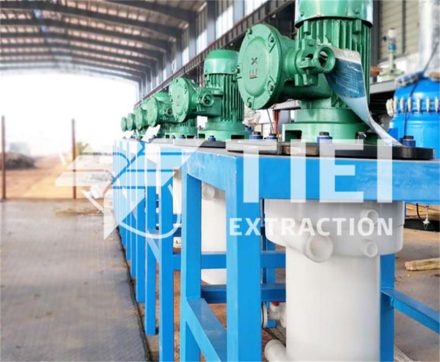
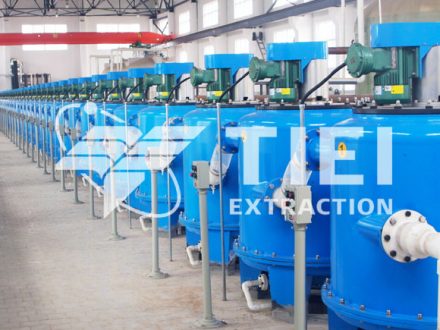
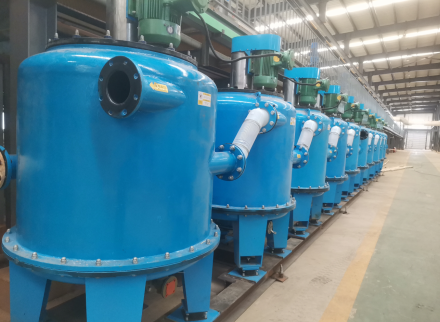
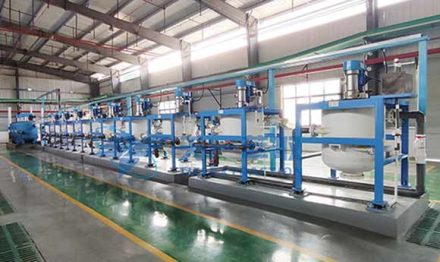
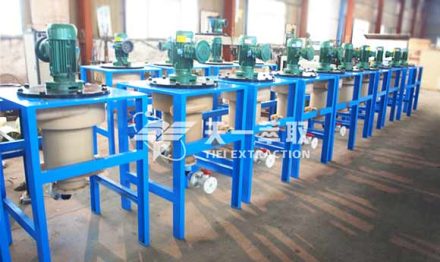
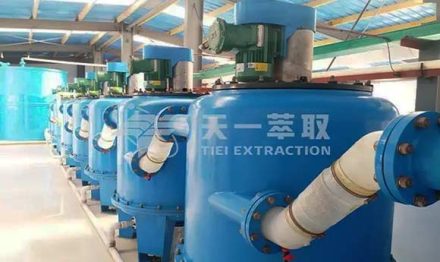
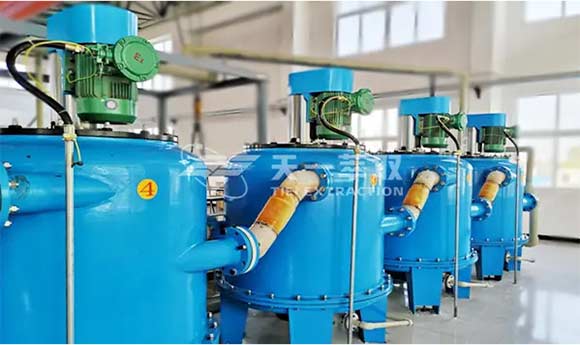
The professional sophistication of the process requires high-performance execution equipment to achieve practical implementation. In the organic acid extraction process developed by Zhengzhou Tiei Extraction, the CWL-M series centrifugal extractor serves as the core unit for mixing, mass transfer, and two-phase separation:
1.Enhanced Mass Transfer Efficiency: The high-speed rotation generates a strong centrifugal force field, allowing the fermentation broth and extractant to instantaneously mix at the micron scale. Mass transfer efficiency is 5–8 times higher than mechanical stirring, and a single-stage extraction rate can exceed 90%.
2.Thorough Phase Separation, Eliminating Entrainment: Centrifugal forces reach thousands of times gravity, enabling the two phases to separate in milliseconds. The interface is clear and stable, water content in the organic phase can be controlled below 1%, and extractant loss is significantly reduced.
3.Corrosion-Resistant and Long Lifespan: Flow-through components use a composite of perfluorinated polymers and special alloys, resisting long-term corrosion from lactic acid, succinic acid, and extractants. The main equipment lifetime exceeds 8 years, and maintenance frequency is reduced by 90%.
4.Automated, Seamlessly Integrated: The equipment supports DCS system integration, with real-time adjustment of rotation speed, phase ratio, temperature, and automatic recording and traceability of operating data. This enables unmanned operation of the extraction unit, leaving the era of experience-based manual operation behind.
Industrial Validation: Stable Operation from Ton-Scale to 100,000 Tons
Take, for example, a biotechnology company with an annual lactic acid production of 50,000 tons. The original process used the calcium salt method, achieving a comprehensive lactic acid yield of approximately 78%, generating 2.5 tons of solid waste per ton of product, with environmental treatment costs as high as 1,200 RMB per ton.
After retrofitting with a four-stage countercurrent CWL-M centrifugal extraction system, the lactic acid yield stabilized at 99.2%, the COD of the raffinate decreased by 60%, and the stripping solution could enter the concentration stage directly. The comprehensive cost per ton dropped by 1,800 RMB, and the project payback period was under 14 months. The annual extractant loss rate was below 1.5%, truly achieving low consumption and high efficiency.
Zhengzhou Tiei Extraction Technology Co., Ltd. offers clients complete verification services for organic acid extraction from bio-fermentation broths. We not only provide high-performance liquid–liquid extraction equipment, but are also committed to becoming a technical partner for quality upgrades and green transformation in the biomanufacturing industry.
Email: sales@tieiextraction.com
Whatsapp: +86 19069612820