Zinc sulfate, as an important inorganic chemical raw material, is widely used in electroplating, agriculture, pharmaceuticals, new energy materials, and many other industries, with continuously growing market demand. Currently, zinc sulfate production mainly relies on hydrometallurgical processes, extracting and purifying zinc from zinc ore leach solutions and industrial zinc-containing wastewater. However, traditional extraction technologies generally suffer from slow phase separation, severe emulsification, low zinc recovery rates, difficulty in removing impurities, and high energy consumption. These challenges not only lead to zinc resource waste, but also make it difficult to meet the increasing demand for high-purity zinc sulfate in high-end applications.
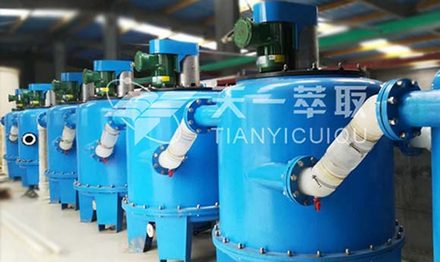
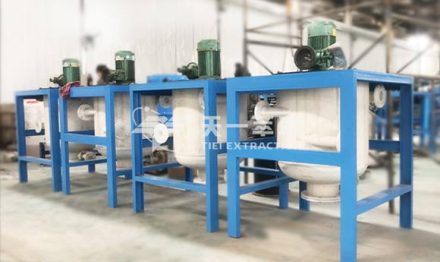
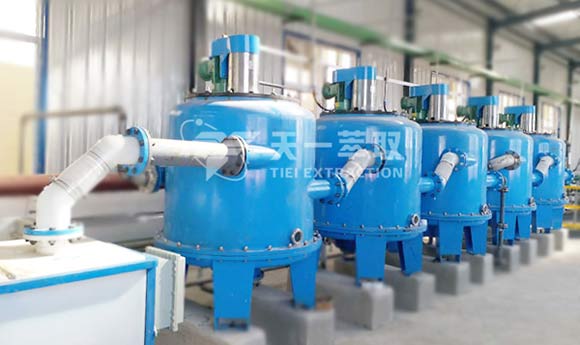
The CWL-M centrifugal extractor, independently developed by Zhengzhou Tiei Extraction, effectively addresses these industry bottlenecks by enabling efficient extraction, deep purification, and closed-loop resource recovery of zinc sulfate, promoting the transformation of the zinc sulfate industry toward higher efficiency, lower energy consumption, and greener production.
Industry Challenges in Zinc Sulfate Extraction
The primary raw materials for zinc sulfate extraction include zinc ore roasting leachate, zinc salt production wastewater, and electroplating effluent. These feed solutions are highly complex, containing not only zinc sulfate but also impurity ions such as iron, copper, lead, and cadmium, often under strongly acidic conditions. Traditional extraction processes face several major limitations:
1.Low Phase Separation Efficiency and Severe Emulsification: Traditional mixer-settler systems rely on gravity settling, with phase separation times ranging from 30 to 90 minutes. Colloidal impurities in the feed solution easily form stable emulsion layers, causing significant zinc entrainment losses and limiting zinc sulfate recovery rates to around 85%.
2.Poor Selectivity and Insufficient Product Purity: Traditional extraction processes often exhibit high co-extraction rates of impurities. In particular, iron co-extraction rates can exceed 15%, resulting in complicated downstream purification procedures and increased production costs. As a result, it is difficult to produce high-end zinc sulfate products with purity levels of ≥99.95%.
3.High Energy Consumption and Large Footprint: Multi-stage mixer settlers require floor space up to ten times larger than centrifugal extraction equipment, while solvent loss rates typically range from 1% to 3%. These drawbacks are increasingly incompatible with modern requirements for green manufacturing and large-scale industrial production.
4.Poor Corrosion Resistance and High Maintenance Costs: Strongly acidic process solutions can severely corrode conventional equipment, reducing operational stability during continuous production and leading to high maintenance expenses.
With increasingly stringent environmental regulations and growing demand for high-purity zinc sulfate products, the industry urgently requires extraction equipment featuring high separation efficiency, excellent selectivity, low energy consumption, and superior corrosion resistance. Against this backdrop, centrifugal extraction technology has emerged as the optimal solution for zinc sulfate extraction and purification.
Zinc Sulfate Extraction Process
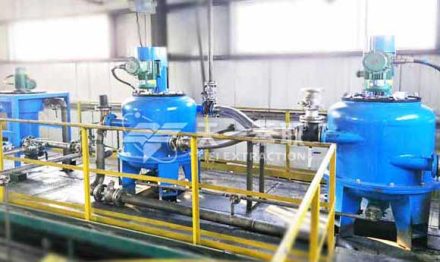
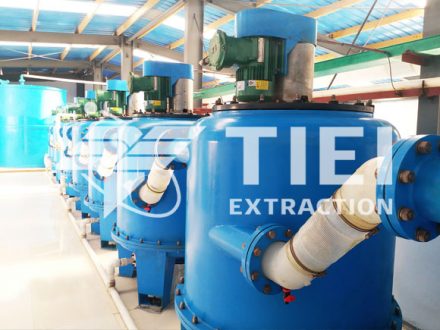
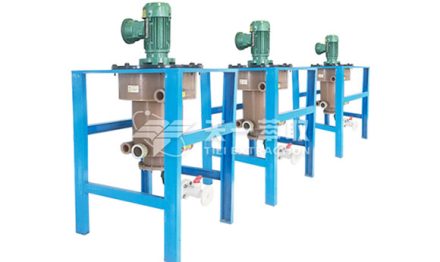
The CWL-M centrifugal extractor is a rapid and highly efficient liquid-liquid extraction and separation equipment. Driven by a motor, the high-speed rotating drum enables two immiscible liquids with different densities to complete mixing and mass transfer under strong shear force, followed by rapid phase separation under centrifugal force generated by high-speed rotation.
In the zinc sulfate extraction process, the zinc sulfate feed solution (aqueous phase) and the specialized organic phase undergo intense millisecond-level shear mixing in the mixing zone. The liquid droplets are refined to 50–200 μm, significantly increasing the interfacial area for mass transfer and allowing zinc ions to rapidly transfer from the aqueous phase to the organic phase. The mixed liquid then enters the separation zone, where the aqueous phase (raffinate phase) and organic phase (loaded phase) are rapidly separated within 3–30 seconds under centrifugal force. The phase interface remains clear and stable, completely eliminating emulsification and entrainment problems, while improving separation efficiency by 5–10 times compared with traditional equipment.
To meet the process requirements of zinc sulfate extraction, the system adopts a complete process flow of “Pretreatment → Multi-stage Countercurrent Extraction → Washing & Purification → Stripping & Regeneration → Solvent Closed-loop Recycling,” making it highly suitable for continuous industrial production.
1.Pretreatment: The zinc sulfate-containing feed solution is first filtered to remove suspended solids and precipitates. An “iron powder reduction + hydrogen peroxide oxidation” process is applied to break complexed zinc compounds, while the pH is adjusted to around 2.5 to remove hydrolyzable impurities such as silicon and phosphorus, providing a clean feed solution for subsequent extraction.
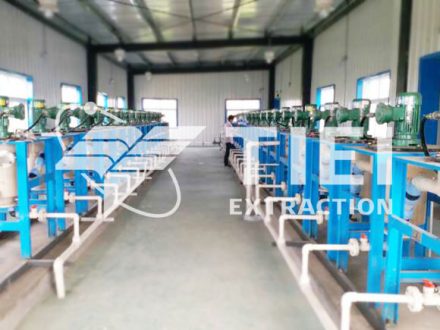
2.Multi-stage Countercurrent Extraction: Multiple CWL-M centrifugal extractors are connected in a modular series configuration. Using a specially formulated composite extractant, the six-stage countercurrent extraction process can achieve a zinc ion extraction rate of over 99.2%, while the co-extraction rate of impurities such as iron and copper remains below 1%.
3.Washing and Purification: The loaded organic phase enters a dedicated washing unit, where diluted sulfuric acid is used as the washing agent to precisely remove trace impurity ions carried over during extraction. Zinc ion loss is controlled below 0.5%, ensuring high purity of the stripping solution.
4.Stripping and Regeneration: Sulfuric acid-containing spent electrolyte is used as the stripping agent. At approximately 45°C, zinc ions are effectively stripped and transferred from the organic phase back into the aqueous phase, producing a high-concentration zinc sulfate solution that can be directly used for subsequent refining processes.
5.Solvent Closed-loop Recycling: After stripping, the organic phase is regenerated through distillation and purification. The solvent can be recycled more than 200 times, while solvent loss is maintained below 0.8%, enabling environmentally friendly and sustainable operation.
Advantages of Centrifugal Extraction Technology
Compared with traditional extraction processes, the CWL-M centrifugal extractor offers significant advantages and application value in zinc sulfate extraction.
1.High Efficiency and Low Energy Consumption for Large-scale Production
Single-stage separation efficiency is improved by 3–5 times, while overall energy consumption is reduced by 30%–50%. The CWL-M centrifugal extractor footprint is only one-tenth that of traditional mixer settlers. A single CWL650-M unit can process up to 30,000 tons annually, making it suitable for large-scale zinc sulfate production projects.
2.High Recovery Rate and High Purity
The comprehensive recovery rate of zinc sulfate exceeds 99%. After refining, the stripping solution purity can reach over 99.95%, making it suitable for high-end applications such as electroplating and new energy materials, while significantly increasing product value.
3.Excellent Corrosion Resistance and Stable Operation
The CWL-M centrifugal extractor adopts a 316L stainless steel structure with fluoroplastic composite coating, allowing it to withstand highly corrosive environments with pH values ranging from 0 to 14. Continuous operation for over 7,200 hours without failure significantly reduces maintenance costs by more than 60%.
4.Environmentally Friendly and Cost-effective
The fully enclosed operating system minimizes extractant volatilization. Zinc concentration in the raffinate is controlled below 0.1 g/L, allowing for recycling or compliant discharge. The solvent recycling rate exceeds 98%, greatly reducing both raw material consumption and environmental treatment costs.
Driven by the development of the circular economy, zinc sulfate production is rapidly evolving toward greener, larger-scale, and higher-value manufacturing. Resource recovery from low-grade ores and industrial wastewater has become a key industry focus. With its core advantages of high efficiency, low energy consumption, and environmental sustainability, the CWL-M centrifugal extractor has become one of the mainstream solutions for zinc sulfate extraction and purification, promoting technological advancement in the hydrometallurgical industry.
Email: sales@tieiextraction.com
Whatsapp: +86 19069612820